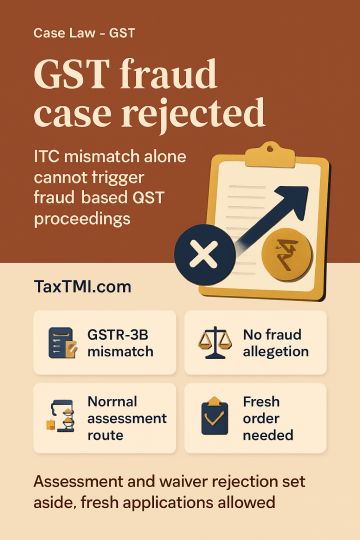
Fraud-based GST assessment cannot stand without allegations of fraud, wilful misstatement or suppression; proceedings must follow normal classificatio...
Page of 4788
Press 'Enter' after typing page number.
1001 to 1020 of 95752 Results
❮
❯
❯❯
0 / 200
Expand Note
Add to Folder
No Folders have been created
+
Are you sure you want to delete "My most important" ?
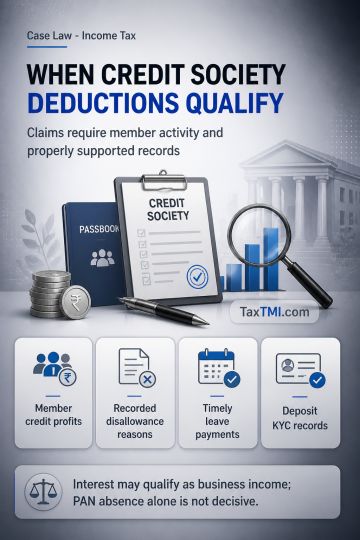
Section 80P deductions for a co-operative credit society are addressed in relation to profits from providing credit facilities to members, interest income attributable to that activity, and any residual deduction where income remains. The notes state that disallowances require recorded reasons and that interest characterised as business income may qualify under section 80P(2)(a)(i), while an alternative claim under section 80P(2)(d) may not arise. Audit-fee provisions require evidence of an accrued, non-contingent liability. Leave-encashment provisions require proof of payment within the prescribed return-filing period. Member deposits require KYC particulars mandated by applicable co-operative law and RBI guidelines; absence of PAN alone is not decisive.
Section 80P deductions for a co-operative credit society are addressed in relation to profits from providing credit facilities to members, interest income attributable to that activity, and any residual deduction where income remains. The notes state that disallowances require recorded reasons and that interest characterised as business income may qualify under section 80P(2)(a)(i), while an alternative claim under section 80P(2)(d) may not arise. Audit-fee provisions require evidence of an accrued, non-contingent liability. Leave-encashment provisions require proof of payment within the prescribed return-filing period. Member deposits require KYC particulars mandated by applicable co-operative law and RBI guidelines; absence of PAN alone is not decisive.
Note: It is a system-generated summary and is for quick reference only.
 TaxTMI
 of 4788













 Join Channel


 TaxTMI