Defined public benefit can retain charitable character; registration renewal requires examining genuine activities and legal compliance, not surplus a...
Capital reduction is distinct from share buy-back, preventing buy-back tax; restructuring interest and related business deductions also survive scruti...
Transfer pricing and tax deductions upheld on established principles, while employee contributions and warranty provisions returned for fresh examinat...
Captive transfer pricing relies on industrial consumer tariffs, while genuine quotations can benchmark effluent treatment transfers under the Other Me...
Specific tariff classification for ophthalmic instruments and extended limitation principles determine the treatment of duty demands, confiscation, an...
Integrated golf function determines classification, placing launch monitors and simulators under other golf equipment rather than measuring instrument...
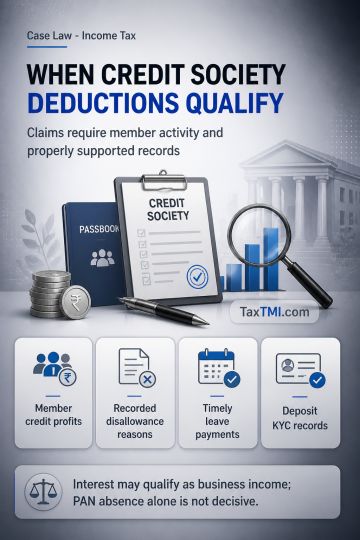
Section 80P deductions for a co-operative credit society are addressed in relation to profits from providing credit facilities to members, interest income attributable to that activity, and any residual deduction where income remains. The notes state that disallowances require recorded reasons and that interest characterised as business income may qualify under section 80P(2)(a)(i), while an alternative claim under section 80P(2)(d) may not arise. Audit-fee provisions require evidence of an accrued, non-contingent liability. Leave-encashment provisions require proof of payment within the prescribed return-filing period. Member deposits require KYC particulars mandated by applicable co-operative law and RBI guidelines; absence of PAN alone is not decisive.
Section 80P deductions for a co-operative credit society are addressed in relation to profits from providing credit facilities to members, interest income attributable to that activity, and any residual deduction where income remains. The notes state that disallowances require recorded reasons and that interest characterised as business income may qualify under section 80P(2)(a)(i), while an alternative claim under section 80P(2)(d) may not arise. Audit-fee provisions require evidence of an accrued, non-contingent liability. Leave-encashment provisions require proof of payment within the prescribed return-filing period. Member deposits require KYC particulars mandated by applicable co-operative law and RBI guidelines; absence of PAN alone is not decisive.
Note: It is a system-generated summary and is for quick reference only.
 TaxTMI
 of 4786



















 Join Channel


 TaxTMI
