Transfer pricing and tax deductions upheld on established principles, while employee contributions and warranty provisions returned for fresh examinat...
Captive transfer pricing relies on industrial consumer tariffs, while genuine quotations can benchmark effluent treatment transfers under the Other Me...
Specific tariff classification for ophthalmic instruments and extended limitation principles determine the treatment of duty demands, confiscation, an...
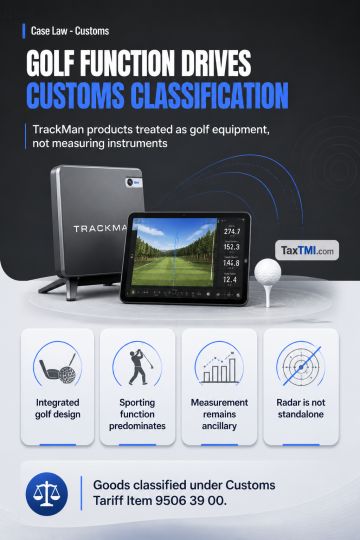
Integrated golf function determines classification, placing launch monitors and simulators under other golf equipment rather than measuring instrument...
Public servant status under anti-corruption law extends to recognised stock exchange leadership; constitutional and sanction challenges do not succeed...
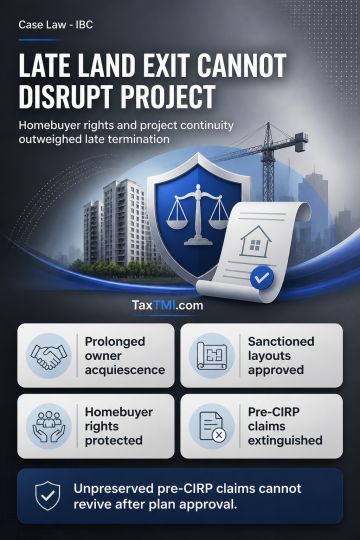
Acquiescence, homebuyer protection and clean-slate resolution principles prevent landowners from disrupting an integrated project through late termina...
Page of 4792
Press 'Enter' after typing page number.
1001 to 1020 of 95833 Results
❮
❯
❯❯
0 / 200
Expand Note
Add to Folder
No Folders have been created
+
Are you sure you want to delete "My most important" ?
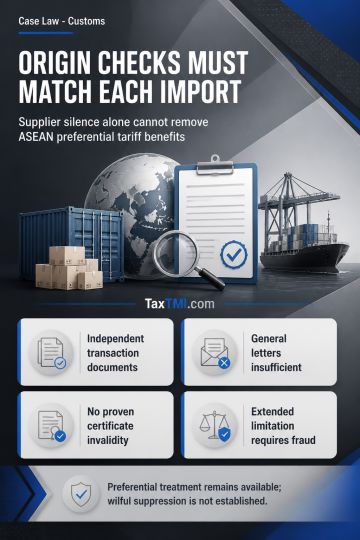
Preferential tariff benefit under the ASEAN-India Free Trade Area cannot be denied solely because an overseas supplier did not cooperate in a general origin-verification exercise. Each Certificate of Origin is an independent statutory document for a distinct import transaction and requires transaction-specific verification; departmental correspondence does not itself invalidate certificates issued by the exporting country's designated authority. In the absence of findings that the certificates were forged, cancelled, fraudulently obtained or otherwise invalid, the article states that preferential duty treatment remains available. It also explains that extended limitation requires Revenue to prove fraud, collusion, wilful misstatement or intentional suppression; an openly disclosed claim supported by certificates accepted at assessment does not establish wilful suppression.
Preferential tariff benefit under the ASEAN-India Free Trade Area cannot be denied solely because an overseas supplier did not cooperate in a general origin-verification exercise. Each Certificate of Origin is an independent statutory document for a distinct import transaction and requires transaction-specific verification; departmental correspondence does not itself invalidate certificates issued by the exporting country's designated authority. In the absence of findings that the certificates were forged, cancelled, fraudulently obtained or otherwise invalid, the article states that preferential duty treatment remains available. It also explains that extended limitation requires Revenue to prove fraud, collusion, wilful misstatement or intentional suppression; an openly disclosed claim supported by certificates accepted at assessment does not establish wilful suppression.
Note: It is a system-generated summary and is for quick reference only.
 TaxTMI
 of 4792


















 Join Channel


 TaxTMI