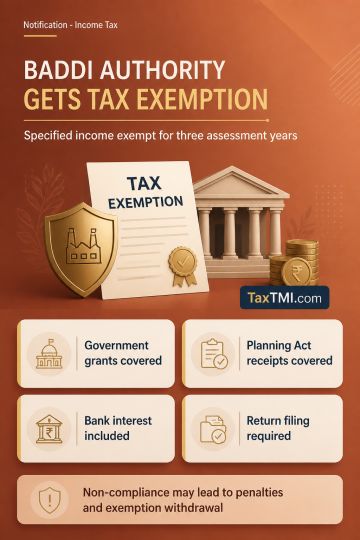
Specified income of Baddi Barotiwala Nalagarh Development Authority receives conditional tax exemption, retrospectively covering its designated assess...
Specified development authority income receives retrospective tax exemption, subject to non-commercial activity, unchanged income sources, and return-...
Unified Brand India framework introduces voluntary Trust Mark certification and funding support for export branding, packaging and global promotional ...
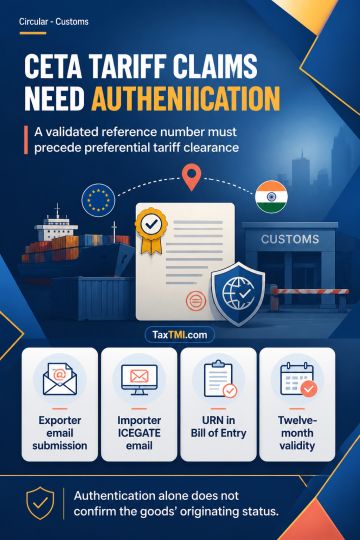
Origin Declaration authentication governs preferential tariff claims under India-UK CETA, requiring a validated reference number before import clearan...
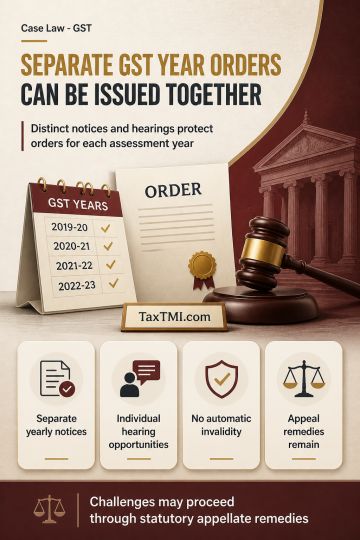
Separate assessment orders for different years remain valid when distinct notices and hearing opportunities prevent prejudice from combined proceeding...
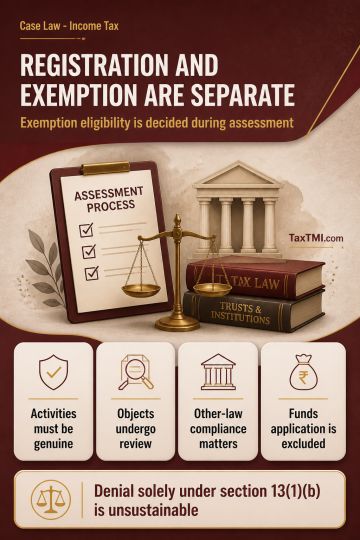
Defined public benefit can retain charitable character; registration renewal requires examining genuine activities and legal compliance, not surplus a...
Page of 4790
Press 'Enter' after typing page number.
941 to 960 of 95794 Results
❮
❯
❯❯
0 / 200
Expand Note
Add to Folder
No Folders have been created
+
Are you sure you want to delete "My most important" ?
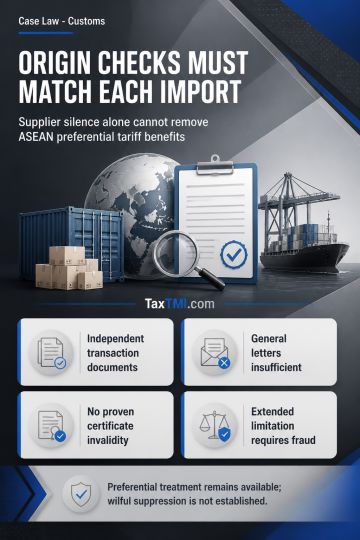
Preferential tariff benefit under the ASEAN-India Free Trade Area cannot be denied solely because an overseas supplier did not cooperate in a general origin-verification exercise. Each Certificate of Origin is an independent statutory document for a distinct import transaction and requires transaction-specific verification; departmental correspondence does not itself invalidate certificates issued by the exporting country's designated authority. In the absence of findings that the certificates were forged, cancelled, fraudulently obtained or otherwise invalid, the article states that preferential duty treatment remains available. It also explains that extended limitation requires Revenue to prove fraud, collusion, wilful misstatement or intentional suppression; an openly disclosed claim supported by certificates accepted at assessment does not establish wilful suppression.
Preferential tariff benefit under the ASEAN-India Free Trade Area cannot be denied solely because an overseas supplier did not cooperate in a general origin-verification exercise. Each Certificate of Origin is an independent statutory document for a distinct import transaction and requires transaction-specific verification; departmental correspondence does not itself invalidate certificates issued by the exporting country's designated authority. In the absence of findings that the certificates were forged, cancelled, fraudulently obtained or otherwise invalid, the article states that preferential duty treatment remains available. It also explains that extended limitation requires Revenue to prove fraud, collusion, wilful misstatement or intentional suppression; an openly disclosed claim supported by certificates accepted at assessment does not establish wilful suppression.
Note: It is a system-generated summary and is for quick reference only.
 TaxTMI
 of 4790










 Join Channel


 TaxTMI

