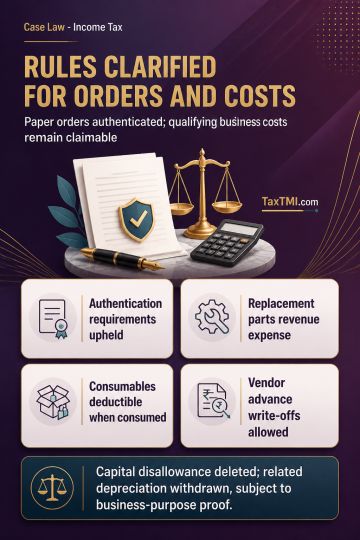
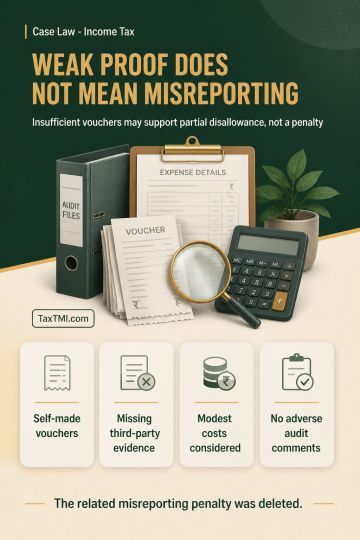
Authentication of paper assessment orders upheld, while qualifying repairs, consumables and vendor advance write-offs remain deductible business claim...
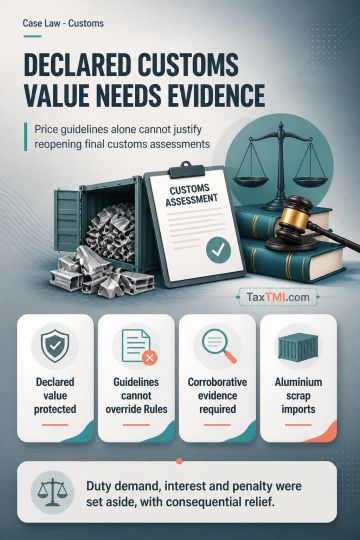
Transaction value cannot be rejected solely on non-statutory valuation guidelines without corroborative evidence supporting reassessment of final cust...
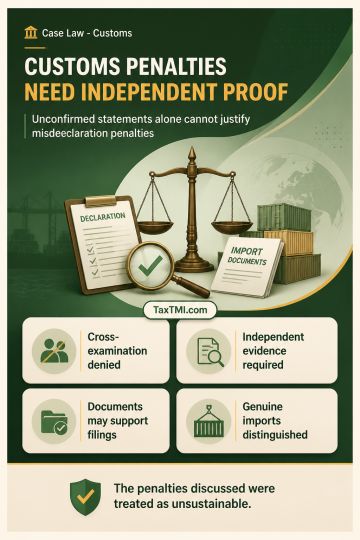
Cross-examination rights and corroborated evidence limit customs penalties for misdeclaration in genuine import transactions involving documented clea...
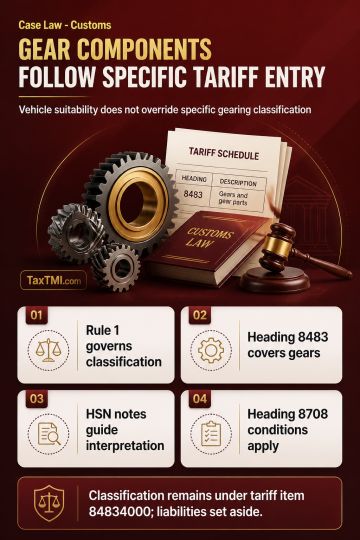
Tariff classification of vehicle gear components follows the specific gearing entry, displacing motor-vehicle parts classification and related liabili...
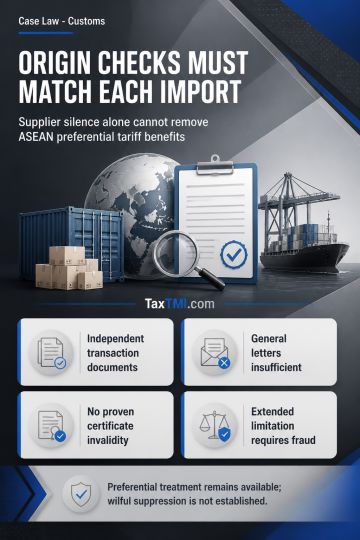
Preferential tariff benefit under the ASEAN-India Free Trade Area cannot be denied solely because an overseas supplier did not cooperate in a general origin-verification exercise. Each Certificate of Origin is an independent statutory document for a distinct import transaction and requires transaction-specific verification; departmental correspondence does not itself invalidate certificates issued by the exporting country's designated authority. In the absence of findings that the certificates were forged, cancelled, fraudulently obtained or otherwise invalid, the article states that preferential duty treatment remains available. It also explains that extended limitation requires Revenue to prove fraud, collusion, wilful misstatement or intentional suppression; an openly disclosed claim supported by certificates accepted at assessment does not establish wilful suppression.
Preferential tariff benefit under the ASEAN-India Free Trade Area cannot be denied solely because an overseas supplier did not cooperate in a general origin-verification exercise. Each Certificate of Origin is an independent statutory document for a distinct import transaction and requires transaction-specific verification; departmental correspondence does not itself invalidate certificates issued by the exporting country's designated authority. In the absence of findings that the certificates were forged, cancelled, fraudulently obtained or otherwise invalid, the article states that preferential duty treatment remains available. It also explains that extended limitation requires Revenue to prove fraud, collusion, wilful misstatement or intentional suppression; an openly disclosed claim supported by certificates accepted at assessment does not establish wilful suppression.
Note: It is a system-generated summary and is for quick reference only.
 TaxTMI
 of 4782






 Join Channel


 TaxTMI