Specified income of Baddi Barotiwala Nalagarh Development Authority receives conditional tax exemption, retrospectively covering its designated assess...
Specified development authority income receives retrospective tax exemption, subject to non-commercial activity, unchanged income sources, and return-...
Unified Brand India framework introduces voluntary Trust Mark certification and funding support for export branding, packaging and global promotional ...
Origin Declaration authentication governs preferential tariff claims under India-UK CETA, requiring a validated reference number before import clearan...
Separate assessment orders for different years remain valid when distinct notices and hearing opportunities prevent prejudice from combined proceeding...
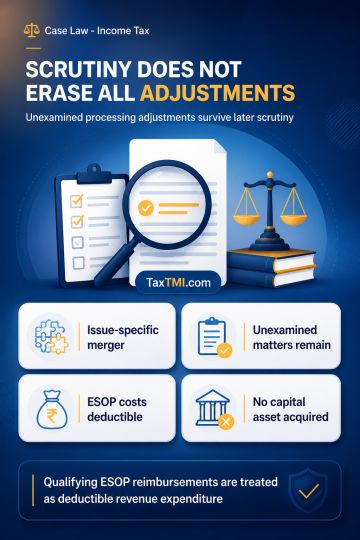
Section 143(1) processing may continue after issuance of a scrutiny notice under section 143(2) for returns from assessment years commencing on or after 1 April 2017. The note explains that merger is issue-specific: only matters actually examined and decided in subsequent scrutiny merge, so unexamined processing adjustments remain separate matters arising from the intimation. It also states that an Assessing Officer need not revisit CPC adjustments merely because scrutiny follows. Cross-charged ESOP costs reimbursed by an Indian subsidiary to its foreign parent are described as employee compensation incurred wholly and exclusively for business, rather than capital expenditure, where the subsidiary neither issues shares nor acquires a capital asset.
Section 143(1) processing may continue after issuance of a scrutiny notice under section 143(2) for returns from assessment years commencing on or after 1 April 2017. The note explains that merger is issue-specific: only matters actually examined and decided in subsequent scrutiny merge, so unexamined processing adjustments remain separate matters arising from the intimation. It also states that an Assessing Officer need not revisit CPC adjustments merely because scrutiny follows. Cross-charged ESOP costs reimbursed by an Indian subsidiary to its foreign parent are described as employee compensation incurred wholly and exclusively for business, rather than capital expenditure, where the subsidiary neither issues shares nor acquires a capital asset.
Note: It is a system-generated summary and is for quick reference only.
 TaxTMI
 of 4782




















 Join Channel


 TaxTMI

