Prolonged sterilisation of development rights supports capital-gains treatment, while business-income disallowances cannot govern capital-gains comput...
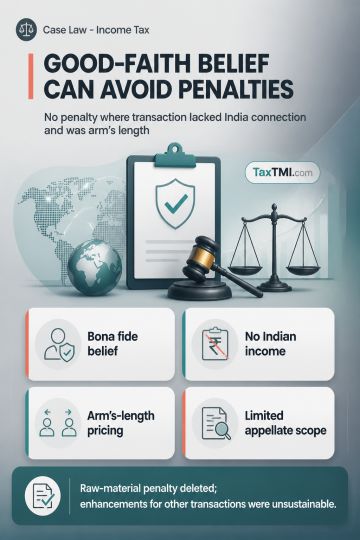
Additional evidence in transfer pricing dispute leads to fresh examination, while tax deductions, TDS credit, fee and refund interest require verifica...
Category II AIF pass-through taxation preserves non-business income character; investment receipts cannot be reclassified without applying recognised ...
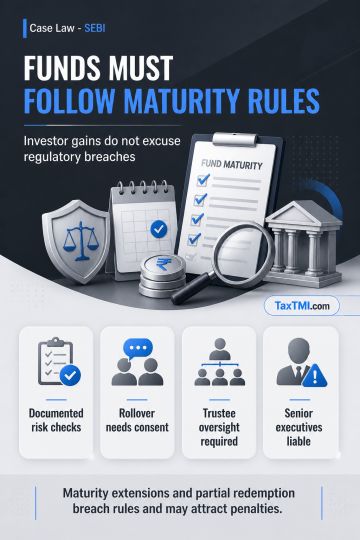
Mutual fund maturity rules require proper rollover, redemption, disclosure, and due diligence; investor gains cannot excuse regulatory breaches or pen...
Threshold exemption excludes exempt services, while stamp-paper purchases avoid reverse charge; consequential service tax penalties were also set asid...
Rectification of mistake is confined to a manifest, self-evident...
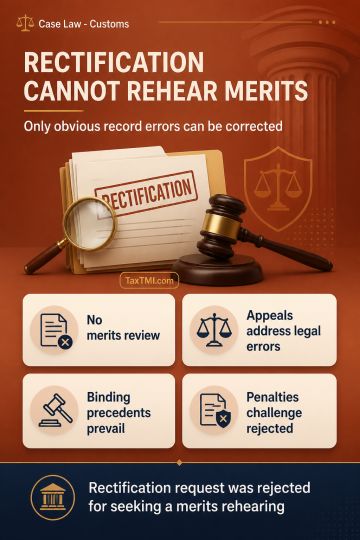
Rectification of mistake remains limited to self-evident record errors, preventing merits review through miscellaneous applications and preserving finality.
Contents
Summary
Note
Bookmark
Share
✓ Copied successfully !
Print
Print Options
For full text, please login
Login to TaxTMI
Verification Pending
The Email Id has not been verified. Click on the link we have sent on
Rectification of mistake is confined to a manifest, self-evident error apparent from the record and cannot require elaborate reasoning, reappreciation of evidence, or reconsideration of legal findings. Errors in reasoning or application of law must be addressed through the prescribed appellate process; applications labelled as clarification, modification, recall, or miscellaneous applications cannot operate as review mechanisms. Binding Supreme Court and jurisdictional High Court precedent must be followed, and a contrary coordinate-bench view does not justify a Larger Bench reference where it disregards binding authority. The text notes that the rectification request concerning confiscation, reverse burden, and penalties was rejected because it sought a merits rehearing rather than correction of an apparent error.
Rectification of mistake is confined to a manifest, self-evident error apparent from the record and cannot require elaborate reasoning, reappreciation of evidence, or reconsideration of legal findings. Errors in reasoning or application of law must be addressed through the prescribed appellate process; applications labelled as clarification, modification, recall, or miscellaneous applications cannot operate as review mechanisms. Binding Supreme Court and jurisdictional High Court precedent must be followed, and a contrary coordinate-bench view does not justify a Larger Bench reference where it disregards binding authority. The text notes that the rectification request concerning confiscation, reverse burden, and penalties was rejected because it sought a merits rehearing rather than correction of an apparent error.
Note: It is a system-generated summary and is for quick reference only.
 TaxTMI
 of 4784



















 Join Channel


 TaxTMI
