Defined public benefit can retain charitable character; registration renewal requires examining genuine activities and legal compliance, not surplus a...
Capital reduction is distinct from share buy-back, preventing buy-back tax; restructuring interest and related business deductions also survive scruti...
Transfer pricing and tax deductions upheld on established principles, while employee contributions and warranty provisions returned for fresh examinat...
Captive transfer pricing relies on industrial consumer tariffs, while genuine quotations can benchmark effluent treatment transfers under the Other Me...
Specific tariff classification for ophthalmic instruments and extended limitation principles determine the treatment of duty demands, confiscation, an...
Integrated golf function determines classification, placing launch monitors and simulators under other golf equipment rather than measuring instrument...
Rectification of mistake is confined to a manifest, self-evident...
Rectification of mistake remains limited to self-evident record errors, preventing merits review through miscellaneous applications and preserving finality.
Contents
Summary
Note
Bookmark
Share
✓ Copied successfully !
Print
Print Options
For full text, please login
Login to TaxTMI
Verification Pending
The Email Id has not been verified. Click on the link we have sent on
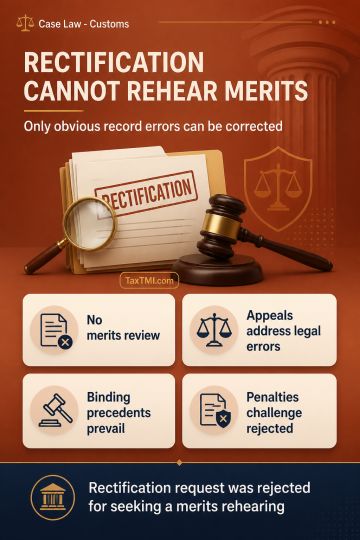
Rectification of mistake is confined to a manifest, self-evident error apparent from the record and cannot require elaborate reasoning, reappreciation of evidence, or reconsideration of legal findings. Errors in reasoning or application of law must be addressed through the prescribed appellate process; applications labelled as clarification, modification, recall, or miscellaneous applications cannot operate as review mechanisms. Binding Supreme Court and jurisdictional High Court precedent must be followed, and a contrary coordinate-bench view does not justify a Larger Bench reference where it disregards binding authority. The text notes that the rectification request concerning confiscation, reverse burden, and penalties was rejected because it sought a merits rehearing rather than correction of an apparent error.
Rectification of mistake is confined to a manifest, self-evident error apparent from the record and cannot require elaborate reasoning, reappreciation of evidence, or reconsideration of legal findings. Errors in reasoning or application of law must be addressed through the prescribed appellate process; applications labelled as clarification, modification, recall, or miscellaneous applications cannot operate as review mechanisms. Binding Supreme Court and jurisdictional High Court precedent must be followed, and a contrary coordinate-bench view does not justify a Larger Bench reference where it disregards binding authority. The text notes that the rectification request concerning confiscation, reverse burden, and penalties was rejected because it sought a merits rehearing rather than correction of an apparent error.
Note: It is a system-generated summary and is for quick reference only.
 TaxTMI
 of 4782






















 Join Channel


 TaxTMI
