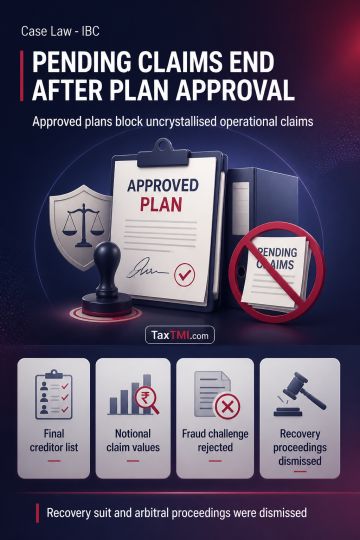
Clean slate principle extinguishes uncrystallised operational claims and bars continuation of pending recovery and arbitral proceedings after plan app...
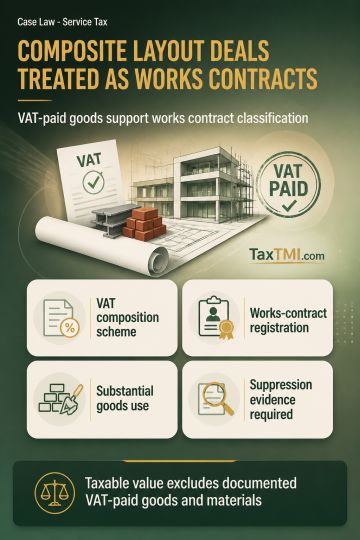
Works contract classification governs composite layout-development contracts where VAT-paid goods are transferred alongside construction and infrastru...
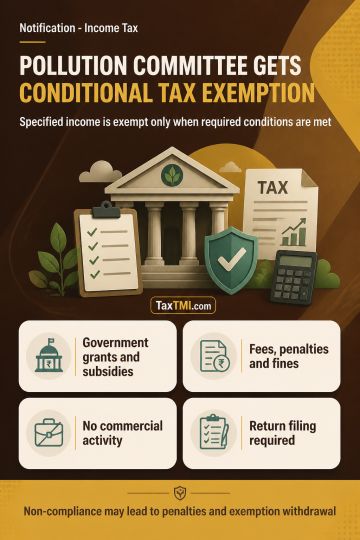
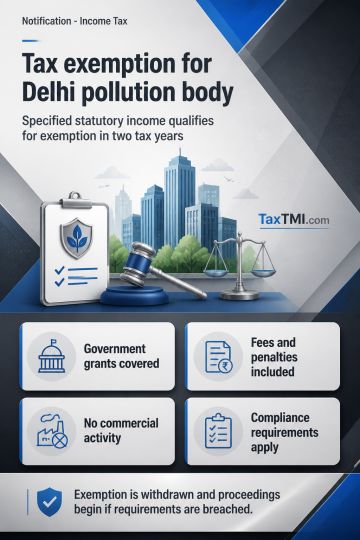
Specified income tax exemption for pollution control body remains conditional on non-commercial activity, unchanged income character, and return filin...
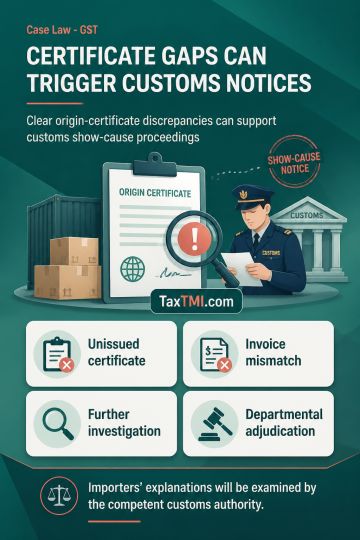
Jurisdictional facts in certificate-of-origin discrepancies can support customs show-cause proceedings, leaving factual explanations for departmental ...
Helicopter charter hire is described as supply of tangible goods...
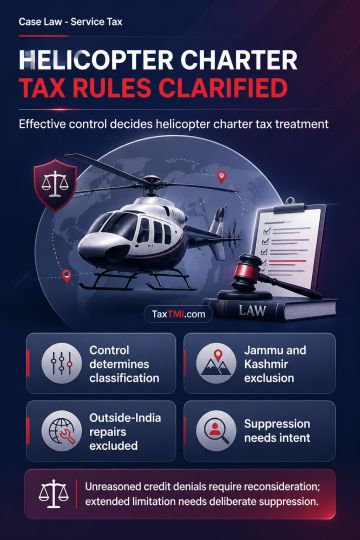
Helicopter charter classification requires effective control analysis, while territorial performance, reasoned credit orders and wilful suppression determine tax consequences.
Contents
Summary
Note
Bookmark
Share
✓ Copied successfully !
Print
Print Options
For full text, please login
Login to TaxTMI
Verification Pending
The Email Id has not been verified. Click on the link we have sent on
Helicopter charter hire is described as supply of tangible goods for use where customers do not obtain possession or effective control, while distinct operational services cannot be combined under that category. Charter services performed wholly in Jammu and Kashmir are treated as outside the taxable territory under the destination-based levy principle. Reverse-charge tax is inapplicable to spare-parts payments as goods and to repair services performed outside India. A CENVAT credit denial requires a reasoned order addressing invoices, evidence and eligibility; otherwise reconsideration is required. Extended limitation requires deliberate suppression with intent to evade, not mere non-payment or inaction.
Helicopter charter hire is described as supply of tangible goods for use where customers do not obtain possession or effective control, while distinct operational services cannot be combined under that category. Charter services performed wholly in Jammu and Kashmir are treated as outside the taxable territory under the destination-based levy principle. Reverse-charge tax is inapplicable to spare-parts payments as goods and to repair services performed outside India. A CENVAT credit denial requires a reasoned order addressing invoices, evidence and eligibility; otherwise reconsideration is required. Extended limitation requires deliberate suppression with intent to evade, not mere non-payment or inaction.
Note: It is a system-generated summary and is for quick reference only.
 TaxTMI
 of 4782




 Join Channel


 TaxTMI