Prolonged sterilisation of development rights supports capital-gains treatment, while business-income disallowances cannot govern capital-gains comput...
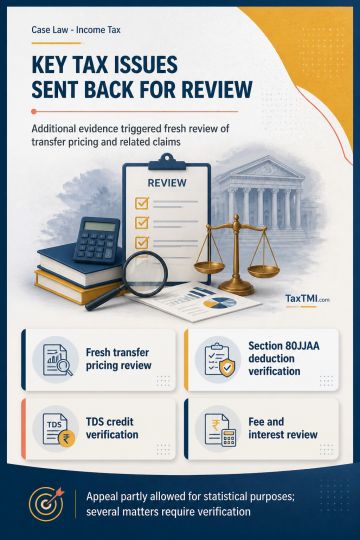
Additional evidence in transfer pricing dispute leads to fresh examination, while tax deductions, TDS credit, fee and refund interest require verifica...
Category II AIF pass-through taxation preserves non-business income character; investment receipts cannot be reclassified without applying recognised ...
Mutual fund maturity rules require proper rollover, redemption, disclosure, and due diligence; investor gains cannot excuse regulatory breaches or pen...
Threshold exemption excludes exempt services, while stamp-paper purchases avoid reverse charge; consequential service tax penalties were also set asid...
At the discharge stage, a strong suspicion based on material capable of being translated into evidence is sufficient, and the court should not conduct a detailed evaluation aimed at conviction. However, prosecution witnesses lacked personal knowledge, merely proved departmental materials, or did not specify the alleged method of excise-duty evasion; the underlying records were not produced, making record-derived evidence inadmissible. Departmental adjudication orders and penalties alone cannot establish criminal liability, as the criminal court must independently assess whether duty evasion occurred and constituted an offence. On the available material, no prima facie case was disclosed, so discharge was upheld and the revision dismissed.
At the discharge stage, a strong suspicion based on material capable of being translated into evidence is sufficient, and the court should not conduct a detailed evaluation aimed at conviction. However, prosecution witnesses lacked personal knowledge, merely proved departmental materials, or did not specify the alleged method of excise-duty evasion; the underlying records were not produced, making record-derived evidence inadmissible. Departmental adjudication orders and penalties alone cannot establish criminal liability, as the criminal court must independently assess whether duty evasion occurred and constituted an offence. On the available material, no prima facie case was disclosed, so discharge was upheld and the revision dismissed.
Note: It is a system-generated summary and is for quick reference only.
 TaxTMI
 of 4784



















 Join Channel



 TaxTMI
