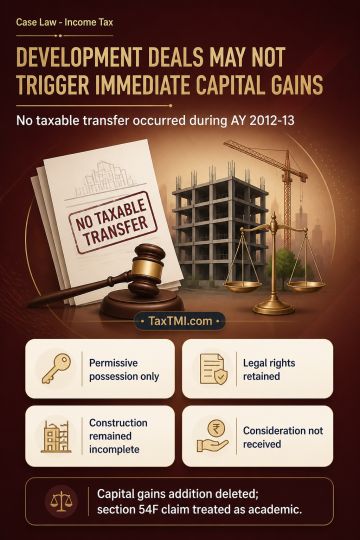
Development agreements require legal possession or effective enjoyment for capital gains transfer; permissive possession and deferred consideration de...
Prolonged sterilisation of development rights supports capital-gains treatment, while business-income disallowances cannot govern capital-gains comput...
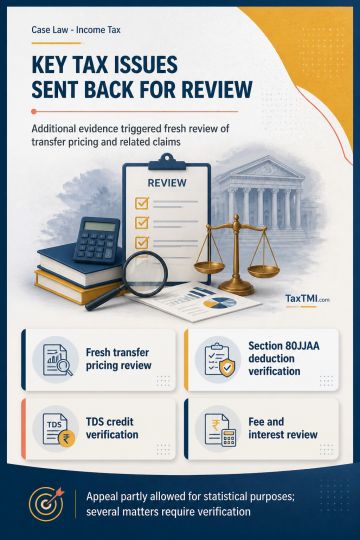
Additional evidence in transfer pricing dispute leads to fresh examination, while tax deductions, TDS credit, fee and refund interest require verifica...
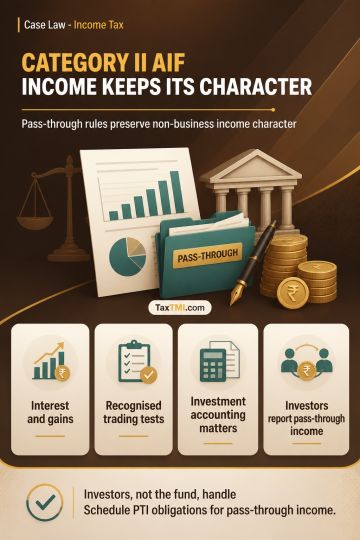
Category II AIF pass-through taxation preserves non-business income character; investment receipts cannot be reclassified without applying recognised ...
Mutual fund maturity rules require proper rollover, redemption, disclosure, and due diligence; investor gains cannot excuse regulatory breaches or pen...
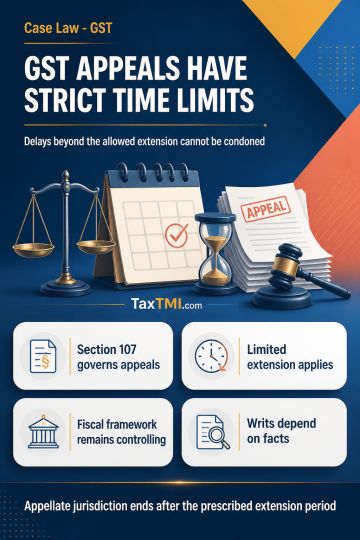
Statutory limitation for GST appeals under Section 107 of the CGST/UKGST Act is treated as an integral and exhaustive part of the appellate remedy. The prescribed appeal period and the limited condonable extension define the Appellate Authority's jurisdiction; therefore, delay beyond that extension cannot be condoned through Section 5 of the Limitation Act. The discussion distinguishes a Supreme Court ruling under beneficial land-acquisition legislation, whose remedial purpose differs from the self-contained fiscal framework of GST. It maintains that fiscal precedents on expressly limited appellate condonation continue to govern unless expressly overruled or distinguished. Individual writ petitions remain for consideration on their respective facts.
Statutory limitation for GST appeals under Section 107 of the CGST/UKGST Act is treated as an integral and exhaustive part of the appellate remedy. The prescribed appeal period and the limited condonable extension define the Appellate Authority's jurisdiction; therefore, delay beyond that extension cannot be condoned through Section 5 of the Limitation Act. The discussion distinguishes a Supreme Court ruling under beneficial land-acquisition legislation, whose remedial purpose differs from the self-contained fiscal framework of GST. It maintains that fiscal precedents on expressly limited appellate condonation continue to govern unless expressly overruled or distinguished. Individual writ petitions remain for consideration on their respective facts.
Note: It is a system-generated summary and is for quick reference only.
 TaxTMI
 of 4782












 Join Channel


 TaxTMI