Defined public benefit can retain charitable character; registration renewal requires examining genuine activities and legal compliance, not surplus a...
Capital reduction is distinct from share buy-back, preventing buy-back tax; restructuring interest and related business deductions also survive scruti...
Transfer pricing and tax deductions upheld on established principles, while employee contributions and warranty provisions returned for fresh examinat...
Captive transfer pricing relies on industrial consumer tariffs, while genuine quotations can benchmark effluent treatment transfers under the Other Me...
Specific tariff classification for ophthalmic instruments and extended limitation principles determine the treatment of duty demands, confiscation, an...
Integrated golf function determines classification, placing launch monitors and simulators under other golf equipment rather than measuring instrument...
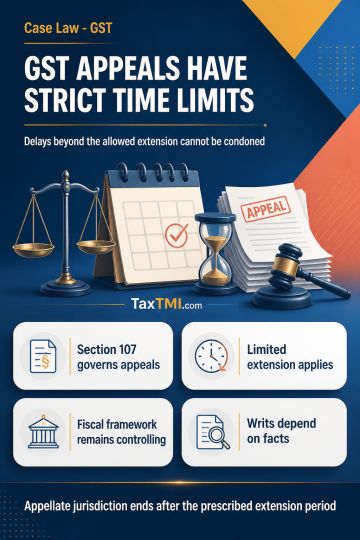
Statutory limitation for GST appeals under Section 107 of the CGST/UKGST Act is treated as an integral and exhaustive part of the appellate remedy. The prescribed appeal period and the limited condonable extension define the Appellate Authority's jurisdiction; therefore, delay beyond that extension cannot be condoned through Section 5 of the Limitation Act. The discussion distinguishes a Supreme Court ruling under beneficial land-acquisition legislation, whose remedial purpose differs from the self-contained fiscal framework of GST. It maintains that fiscal precedents on expressly limited appellate condonation continue to govern unless expressly overruled or distinguished. Individual writ petitions remain for consideration on their respective facts.
Statutory limitation for GST appeals under Section 107 of the CGST/UKGST Act is treated as an integral and exhaustive part of the appellate remedy. The prescribed appeal period and the limited condonable extension define the Appellate Authority's jurisdiction; therefore, delay beyond that extension cannot be condoned through Section 5 of the Limitation Act. The discussion distinguishes a Supreme Court ruling under beneficial land-acquisition legislation, whose remedial purpose differs from the self-contained fiscal framework of GST. It maintains that fiscal precedents on expressly limited appellate condonation continue to govern unless expressly overruled or distinguished. Individual writ petitions remain for consideration on their respective facts.
Note: It is a system-generated summary and is for quick reference only.
 TaxTMI
 of 4782


















 Join Channel


 TaxTMI
