Objective characteristics and principal use govern mining-tyre classification, while fresh advance ruling applications may rely on additional technica...
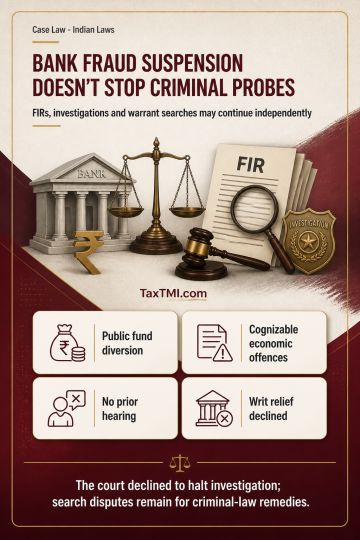
Administrative fraud classification suspension does not halt independent criminal investigation or warrant-based searches into alleged economic offenc...
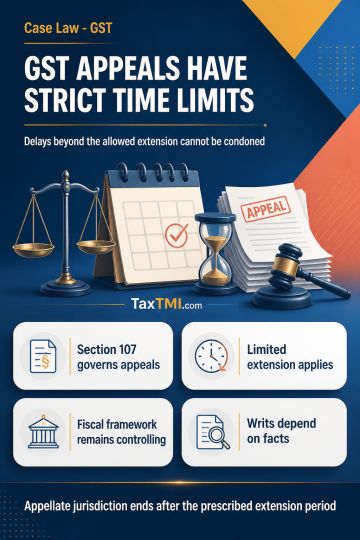
Statutory limitation for GST appeals under Section 107 of the CGST/UKGST Act is treated as an integral and exhaustive part of the appellate remedy. The prescribed appeal period and the limited condonable extension define the Appellate Authority's jurisdiction; therefore, delay beyond that extension cannot be condoned through Section 5 of the Limitation Act. The discussion distinguishes a Supreme Court ruling under beneficial land-acquisition legislation, whose remedial purpose differs from the self-contained fiscal framework of GST. It maintains that fiscal precedents on expressly limited appellate condonation continue to govern unless expressly overruled or distinguished. Individual writ petitions remain for consideration on their respective facts.
Statutory limitation for GST appeals under Section 107 of the CGST/UKGST Act is treated as an integral and exhaustive part of the appellate remedy. The prescribed appeal period and the limited condonable extension define the Appellate Authority's jurisdiction; therefore, delay beyond that extension cannot be condoned through Section 5 of the Limitation Act. The discussion distinguishes a Supreme Court ruling under beneficial land-acquisition legislation, whose remedial purpose differs from the self-contained fiscal framework of GST. It maintains that fiscal precedents on expressly limited appellate condonation continue to govern unless expressly overruled or distinguished. Individual writ petitions remain for consideration on their respective facts.
Note: It is a system-generated summary and is for quick reference only.
 TaxTMI
 of 4782






 Join Channel


 TaxTMI