Just a moment...

Top
Help
×

By creating an account you can:

Logo TaxTMI
Call Us / Help / Feedback

Contact Us At :

E-mail: [email protected]

Call / WhatsApp at: +91 99117 96707

For more information, Check Contact Us

FAQs :

To know Frequently Asked Questions, Check FAQs

Most Asked Video Tutorials :

For more tutorials, Check Video Tutorials

Submit Feedback/Suggestion :

Email :
Please provide your email address so we can follow up on your feedback.
Category :
Description :
Min 15 characters 0/2000
Make Most of Text Search
  1. Checkout this video tutorial: How to search effectively on TaxTMI.
  2. Put words in double quotes for exact word search, eg: "income tax"
  3. Avoid noise words such as : 'and, of, the, a'
  4. Sort by Relevance to get the most relevant document.
  5. Press Enter to add multiple terms/multiple phrases, and then click on Search to Search.
  6. Text Search
  7. The system will try to fetch results that contains ALL your words.
  8. Once you add keywords, you'll see a new 'Search In' filter that makes your results even more precise.
  9. Text Search
Add to...
You have not created any category. Kindly create one to bookmark this item!
Create New Category
Hide
Title :
Description :
❮❮ Hide
Default View
Expand ❯❯
Close ✕
🔎 Highlights - Adv. Search
TEXT SEARCH:

Press 'Enter' to add multiple search terms. Rules for Better Search

Search In:
Main Text + AI Text
  • Main Text
  • Main Text + AI Text
  • AI Text
Law:
---- All Laws----
  • ---- All Laws----
  • Income Tax
  • Direct Taxes
  • Benami Property
  • Central GST Laws
  • SGST - State GST Laws
  • Customs
  • FTP - Foreign Trade Policy
  • SEZ - Special Economic Zone
  • FEMA - Foreign Exchange Management
  • Companies Law
  • SEBI - Securities & Exchange Board of India
  • IBC - Insolvency and Bankruptcy
  • Law of Competition
  • PMLA - Money-Laundering
  • Indian Laws
  • Bill / Finance Bills
  • Wealth Tax
  • Service Tax
  • Central Excise
  • VAT / Sales Tax
Month:
---- All Months ----
  • ---- All Months ----
  • January
  • February
  • March
  • April
  • May
  • June
  • July
  • August
  • September
  • October
  • November
  • December
Year:
---- All Years ----
  • ---- All Years ----
  • 2026
  • 2025
  • 2024
  • 2023
  • 2022
  • 2021
  • 2020
  • 2019
  • 2018
  • 2017
  • 2016
  • 2015
  • 2014
  • 2013
  • 2012
  • 2011
Sort By: ?
In Sort By 'Default', exact matches for text search are shown at the top, followed by the remaining results in their regular order.
Relevance Default Date
    Efficacious appellate remedy bars writ review in GST demand disputes where factual issues require statutory appeal.
    Personal hearing and statutory appeal under GST: writ challenge failed where no reply was filed and no hearing was sought.
    Composite GST assessment for multiple years is impermissible; year-wise proceedings required and fresh action permitted with limitation exclusion.
    Refund of appellate pre-deposit must follow Rule 89, not Section 54, and cannot be withheld on a non-existent investigation.
    Natural justice in ex parte adjudication requires proved service of hearing notices before an appellate order can stand.
    Personal hearing under Section 75(4) is mandatory before adverse adjudication; absence of hearing vitiates the order.
    Electronic Credit Ledger blocking under Rule 86A(3) lapses automatically after one year, requiring immediate unblocking.
    Natural justice breached by non-service of notice, leading to quashing of assessment and recovery proceedings.
    Buy-back of own shares is capital reduction, so section 56(2)(x) cannot tax the price difference.
    Limitation for section 201 proceedings turns on valid show-cause notice; information letters do not start proceedings, and time-bar applies.
    BSNL VRS compensation qualifies as retrenchment compensation, making the receipt exempt from tax subject to verification.
    Invalid jurisdiction in post-search assessment led the ITAT to quash the regular scrutiny assessment.
    Section 153C jurisdiction in search cases depends on handover date of seized material; assessment under section 143(3) was invalid.
    Reassessment beyond four years invalid where reasons lacked failure to disclose, reflected transactions, and sanction was absent.
    Faceless assessment notice must cover specific prejudicial variations; unexplained final additions without notice breach section 144B and natural just...
    Penalty under section 270A was premature where the quantum addition was remanded for fresh adjudication.
    Reassessment after search upheld, but additions on sale of investments deleted for lack of corroborated evidence and cross-examination.
    Mandatory DVO reference under stamp valuation rules defeated capital gains addition and barred post-assessment remand.
    Revenue expenditure and DTAA fixed base test: franchise fees upheld, while TDS issue was remanded for verification.
    Foreign contribution disclosed in the wrong schedule could not be taxed where the receipt was otherwise fully reported.
❯❯
Maximize Maximize Maximize
0 / 200
Expand Note
Add to Folder

No Folders have been created

+

Are you sure you want to delete "My most important" ?

NOTE:

Highlights
Showing Results for :
Reset Filters
Results Found:
Show All Summaries Hide All Summaries

Highlights

Back

All Highlights

Showing Results for :
Reset Filters
No Records Found

Highlights

Back

All Highlights

whatsapp Join Channel
Showing Results for : Reset Filters

Parallel Central and State GST proceedings on the same subject...

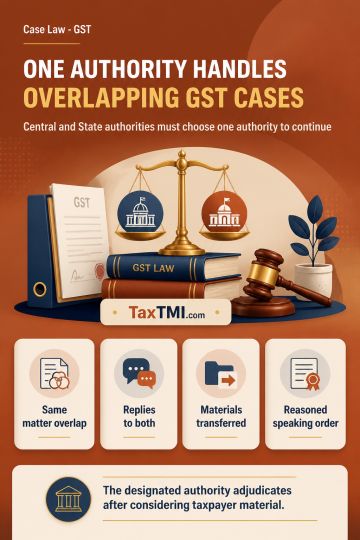
Overlapping GST proceedings require Central and State authorities to designate one competent authority for coordinated adjudication of the same matter.

Contents
Summary
Note

Note

-

Bookmark

Print

Print

GST July 22, 2026 Case Laws HC
Parallel Central and State GST proceedings on the same subject matter require coordination to identify the competent authority. The text explains that proceedings formally commence through show cause notices and overlap where they concern identical or overlapping tax liability, deficiency or obligation arising from the same contravention. A taxable person must submit replies and supporting material to both authorities. Where the subject matter is the same, the authorities must determine between themselves which authority will continue; the other authority must transfer its material. The designated authority must then adjudicate after considering the taxpayer's material through a speaking and reasoned order.

Topics

Acts Income Tax