Inherited property sale proceeds require capital-gains treatment where ownership is supported by evidence, not suspicion or unverified signature doubt...
Cross-examination of retracted statements is essential where foundational evidence supports a benami allegation and documented funding explanations re...
Capital-goods exemption covers plant-modernisation accessories, while the import restriction applies only to earlier capital-goods components and spar...
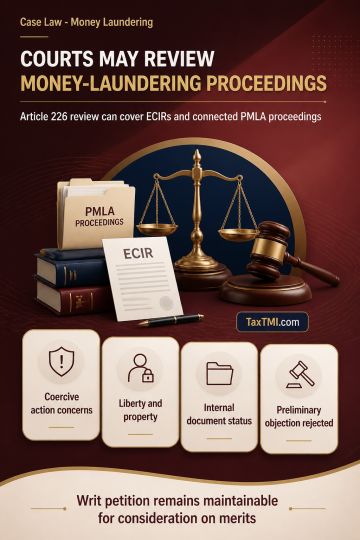
Constitutional judicial review permits challenges to ECIRs and connected money-laundering proceedings where coercive action affects fundamental intere...
Input tax credit should not be denied to a bona fide purchasing dealer solely because the registered selling dealer, despite receiving tax, failed to file returns. Where the purchaser has paid tax against a valid tax invoice, recovery of unpaid tax should be pursued against the defaulting seller. Action against the purchaser remains available where material establishes collusion. Applying this principle, the discussed High Court decision quashed the demand based on alleged excess input tax credit for the relevant financial year, while preserving the authorities' right to recover dues from the selling dealer in accordance with law.
Input tax credit should not be denied to a bona fide purchasing dealer solely because the registered selling dealer, despite receiving tax, failed to file returns. Where the purchaser has paid tax against a valid tax invoice, recovery of unpaid tax should be pursued against the defaulting seller. Action against the purchaser remains available where material establishes collusion. Applying this principle, the discussed High Court decision quashed the demand based on alleged excess input tax credit for the relevant financial year, while preserving the authorities' right to recover dues from the selling dealer in accordance with law.
Note: It is a system-generated summary and is for quick reference only.
 TaxTMI
 of 4786













 Join Channel



 TaxTMI