Defined public benefit can retain charitable character; registration renewal requires examining genuine activities and legal compliance, not surplus a...
Capital reduction is distinct from share buy-back, preventing buy-back tax; restructuring interest and related business deductions also survive scruti...
Transfer pricing and tax deductions upheld on established principles, while employee contributions and warranty provisions returned for fresh examinat...
Captive transfer pricing relies on industrial consumer tariffs, while genuine quotations can benchmark effluent treatment transfers under the Other Me...
Specific tariff classification for ophthalmic instruments and extended limitation principles determine the treatment of duty demands, confiscation, an...
Integrated golf function determines classification, placing launch monitors and simulators under other golf equipment rather than measuring instrument...
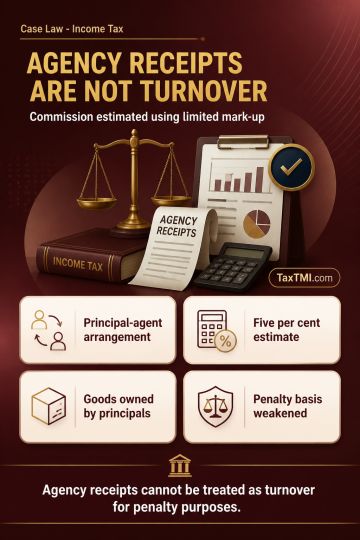
Commission income in agency business should be determined with reference to the limited mark-up permitted under principal-agent arrangements, rather than by applying a net-profit rate to gross bank receipts. The material describes estimation at 5 per cent of gross bank receipts from recharge vouchers and goods. It also addresses penalty for non-maintenance of books where bank receipts represent agency transactions rather than the agent's turnover. As ownership of the goods remains with the principals, such receipts cannot be treated as turnover; absence of evidence of prior-year turnover further undermines the penalty basis.
Commission income in agency business should be determined with reference to the limited mark-up permitted under principal-agent arrangements, rather than by applying a net-profit rate to gross bank receipts. The material describes estimation at 5 per cent of gross bank receipts from recharge vouchers and goods. It also addresses penalty for non-maintenance of books where bank receipts represent agency transactions rather than the agent's turnover. As ownership of the goods remains with the principals, such receipts cannot be treated as turnover; absence of evidence of prior-year turnover further undermines the penalty basis.
Note: It is a system-generated summary and is for quick reference only.
 TaxTMI
 of 4782























 Join Channel


 TaxTMI
