Defined public benefit can retain charitable character; registration renewal requires examining genuine activities and legal compliance, not surplus a...
Capital reduction is distinct from share buy-back, preventing buy-back tax; restructuring interest and related business deductions also survive scruti...
Transfer pricing and tax deductions upheld on established principles, while employee contributions and warranty provisions returned for fresh examinat...
Captive transfer pricing relies on industrial consumer tariffs, while genuine quotations can benchmark effluent treatment transfers under the Other Me...
Specific tariff classification for ophthalmic instruments and extended limitation principles determine the treatment of duty demands, confiscation, an...
Integrated golf function determines classification, placing launch monitors and simulators under other golf equipment rather than measuring instrument...
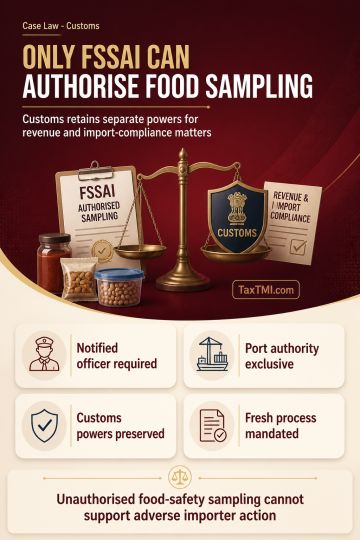
Writ jurisdiction may be invoked despite an alternative review remedy where the challenge concerns the statutory competence of the officer conducting food-safety sampling, rather than laboratory findings. Under the Food Safety and Standards Act and the import regulations, the notified FSSAI Authorised Officer has exclusive authority to take samples for food-safety purposes at the relevant port; a report based on unauthorised sampling cannot support adverse action against an importer. The FSS Act's overriding provision applies to food safety, standards and adulteration, but does not remove Customs powers to take separate samples for classification, valuation, duty, misdeclaration or trade-policy compliance. Fresh food-safety sampling must proceed through the FSSAI Authorised Officer.
Writ jurisdiction may be invoked despite an alternative review remedy where the challenge concerns the statutory competence of the officer conducting food-safety sampling, rather than laboratory findings. Under the Food Safety and Standards Act and the import regulations, the notified FSSAI Authorised Officer has exclusive authority to take samples for food-safety purposes at the relevant port; a report based on unauthorised sampling cannot support adverse action against an importer. The FSS Act's overriding provision applies to food safety, standards and adulteration, but does not remove Customs powers to take separate samples for classification, valuation, duty, misdeclaration or trade-policy compliance. Fresh food-safety sampling must proceed through the FSSAI Authorised Officer.
Note: It is a system-generated summary and is for quick reference only.
 TaxTMI
 of 4782






















 Join Channel


 TaxTMI
