Specified income of Baddi Barotiwala Nalagarh Development Authority receives conditional tax exemption, retrospectively covering its designated assess...
Specified development authority income receives retrospective tax exemption, subject to non-commercial activity, unchanged income sources, and return-...
Unified Brand India framework introduces voluntary Trust Mark certification and funding support for export branding, packaging and global promotional ...
Origin Declaration authentication governs preferential tariff claims under India-UK CETA, requiring a validated reference number before import clearan...
Separate assessment orders for different years remain valid when distinct notices and hearing opportunities prevent prejudice from combined proceeding...
The clean slate principle in corporate insolvency resolution...
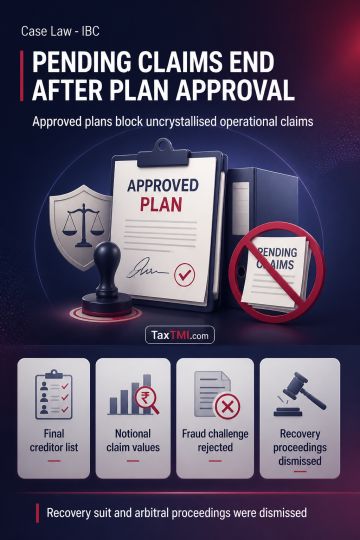
Clean slate principle extinguishes uncrystallised operational claims and bars continuation of pending recovery and arbitral proceedings after plan approval.
Contents
Summary
Note
Bookmark
Share
✓ Copied successfully !
Print
Print Options
For full text, please login
Login to TaxTMI
Verification Pending
The Email Id has not been verified. Click on the link we have sent on
The clean slate principle in corporate insolvency resolution treats an approved resolution plan as final and binding, preventing revival of uncrystallised operational claims. Where disputed civil and arbitral claims were recorded at a notional value and the plan limited payment to crystallised, approved claims, the claims did not survive plan approval. Plan provisions requiring pending proceedings and pre-effective-date operational liabilities to be withdrawn, abated, settled or extinguished operate according to their terms. A fraud-based challenge cannot reopen the plan where the final creditor list was unchallenged, an earlier challenge had attained finality, no recall proceedings were initiated, and the alleged fraud lacked basis. The recovery suit and arbitral proceedings concerning such claims were dismissed.
The clean slate principle in corporate insolvency resolution treats an approved resolution plan as final and binding, preventing revival of uncrystallised operational claims. Where disputed civil and arbitral claims were recorded at a notional value and the plan limited payment to crystallised, approved claims, the claims did not survive plan approval. Plan provisions requiring pending proceedings and pre-effective-date operational liabilities to be withdrawn, abated, settled or extinguished operate according to their terms. A fraud-based challenge cannot reopen the plan where the final creditor list was unchallenged, an earlier challenge had attained finality, no recall proceedings were initiated, and the alleged fraud lacked basis. The recovery suit and arbitral proceedings concerning such claims were dismissed.
Note: It is a system-generated summary and is for quick reference only.
 TaxTMI
 of 4782
















 Join Channel


 TaxTMI