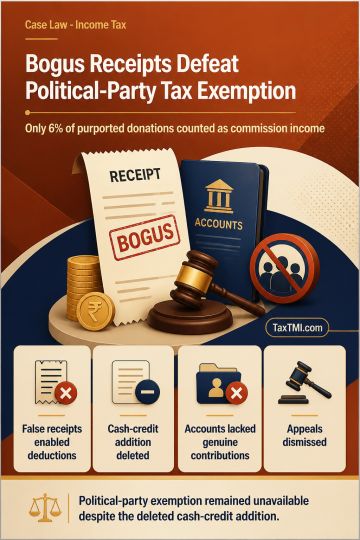
Bogus donation receipts justified commission income assessment and defeated political-party tax exemption for inaccurate accounts and reporting failur...
Pure reimbursement without income element escapes tax withholding, while delayed withholding and unsupported provisions face deferred or renewed scrut...
Public benefit requirement defeats charitable registration where residents' association services are reciprocal, member-only facilities governed by mu...
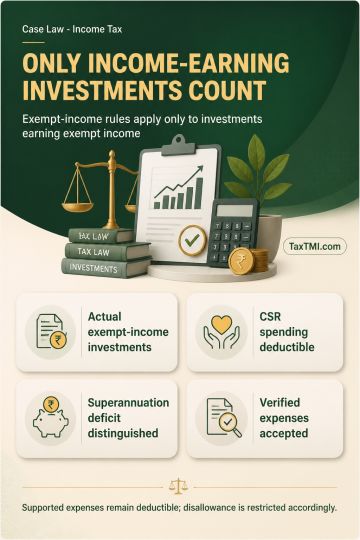
Exempt-income expenditure disallowance is confined to investments that actually generated exempt income, while supported business expenses remain dedu...
For computing profits of a captive power undertaking under...
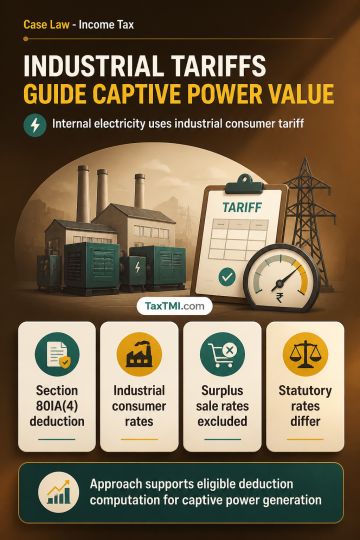
Market value for captive electricity consumption follows industrial consumer tariffs, supporting profit computation for the power generation deduction.
Contents
Summary
Note
Bookmark
Share
✓ Copied successfully !
Print
Print Options
For full text, please login
Login to TaxTMI
Verification Pending
The Email Id has not been verified. Click on the link we have sent on
For computing profits of a captive power undertaking under section 80IA(4), the market value of electricity used internally is described as the tariff at which the Electricity Board supplies electricity to industrial consumers. The rate paid by the Electricity Board for surplus electricity generated is not treated as the relevant market value because it is set through statutory regulation and contractual arrangements rather than the rate payable by an industrial consumer. The note states that this approach supports computation of the eligible deduction for captive power generation.
For computing profits of a captive power undertaking under section 80IA(4), the market value of electricity used internally is described as the tariff at which the Electricity Board supplies electricity to industrial consumers. The rate paid by the Electricity Board for surplus electricity generated is not treated as the relevant market value because it is set through statutory regulation and contractual arrangements rather than the rate payable by an industrial consumer. The note states that this approach supports computation of the eligible deduction for captive power generation.
Note: It is a system-generated summary and is for quick reference only.
 TaxTMI
 of 4786















 Join Channel


 TaxTMI
