Proportionality in company penalty quantification requires aggravating and mitigating factors; mechanical multiplication of director liability is impe...
Page of 4809
Press 'Enter' after typing page number.
3261 to 3280 of 96177 Results
❮
❯
❯❯
0 / 200
Expand Note
Add to Folder
No Folders have been created
+
Are you sure you want to delete "My most important" ?
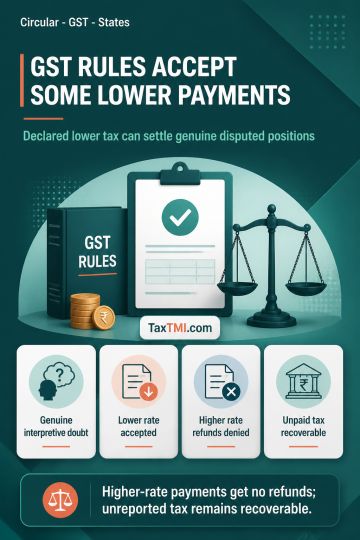
GST regularisation on an "as is" or "as is, where is" basis accepts, as full discharge of liability for the regularised period, tax paid at the lower competing rate or nil rate claimed under a genuinely doubtful exemption entry and declared in returns. Taxpayers who paid a higher rate are not entitled to a refund. The regularisation applies where competing rate entries or divergent interpretations caused genuine doubt; it does not protect cases where no tax was paid when the dispute concerned only competing positive rates. In those cases, tax at the clarified applicable rate remains recoverable.
GST regularisation on an "as is" or "as is, where is" basis accepts, as full discharge of liability for the regularised period, tax paid at the lower competing rate or nil rate claimed under a genuinely doubtful exemption entry and declared in returns. Taxpayers who paid a higher rate are not entitled to a refund. The regularisation applies where competing rate entries or divergent interpretations caused genuine doubt; it does not protect cases where no tax was paid when the dispute concerned only competing positive rates. In those cases, tax at the clarified applicable rate remains recoverable.
Note: It is a system-generated summary and is for quick reference only.
 TaxTMI
  TaxTMI
 of 4809


 Join Channel