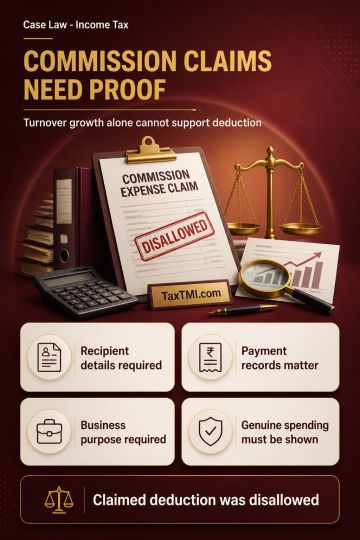
Business expenditure deduction requires proof of genuine commission payments and commercial allowability; turnover growth alone cannot validate the cl...
Article 8 treaty coverage excluded third-party airline support services, while documented demonetisation cash receipts remained accepted business inco...
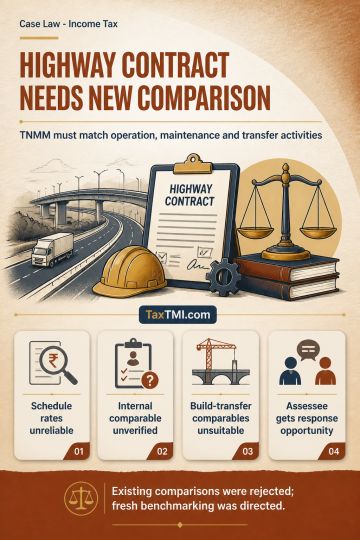
Functional comparability under TNMM requires highway contract benchmarks to reflect operation, maintenance and transfer activities, requiring fresh be...
Page of 4786
Press 'Enter' after typing page number.
241 to 260 of 95715 Results
❮
❯
❯❯
0 / 200
Expand Note
Add to Folder
No Folders have been created
+
Are you sure you want to delete "My most important" ?
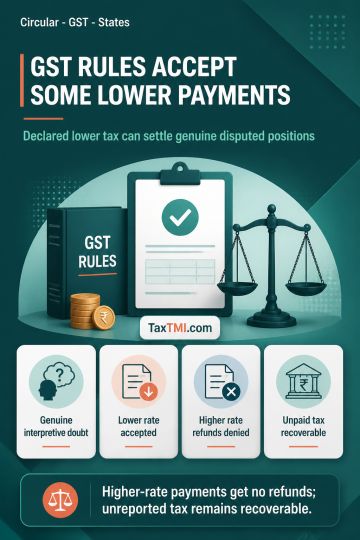
GST regularisation on an "as is" or "as is, where is" basis accepts, as full discharge of liability for the regularised period, tax paid at the lower competing rate or nil rate claimed under a genuinely doubtful exemption entry and declared in returns. Taxpayers who paid a higher rate are not entitled to a refund. The regularisation applies where competing rate entries or divergent interpretations caused genuine doubt; it does not protect cases where no tax was paid when the dispute concerned only competing positive rates. In those cases, tax at the clarified applicable rate remains recoverable.
GST regularisation on an "as is" or "as is, where is" basis accepts, as full discharge of liability for the regularised period, tax paid at the lower competing rate or nil rate claimed under a genuinely doubtful exemption entry and declared in returns. Taxpayers who paid a higher rate are not entitled to a refund. The regularisation applies where competing rate entries or divergent interpretations caused genuine doubt; it does not protect cases where no tax was paid when the dispute concerned only competing positive rates. In those cases, tax at the clarified applicable rate remains recoverable.
Note: It is a system-generated summary and is for quick reference only.
 TaxTMI
 of 4786









 Join Channel


 TaxTMI