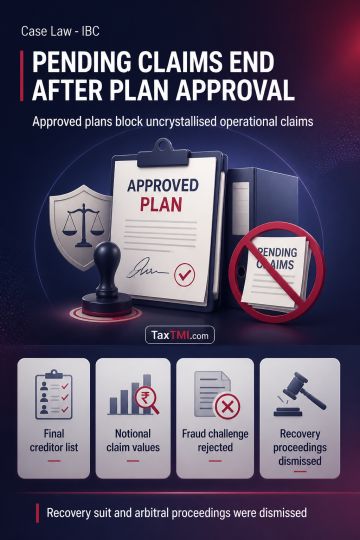
Clean slate principle extinguishes uncrystallised operational claims and bars continuation of pending recovery and arbitral proceedings after plan app...
Works contract classification governs composite layout-development contracts where VAT-paid goods are transferred alongside construction and infrastru...
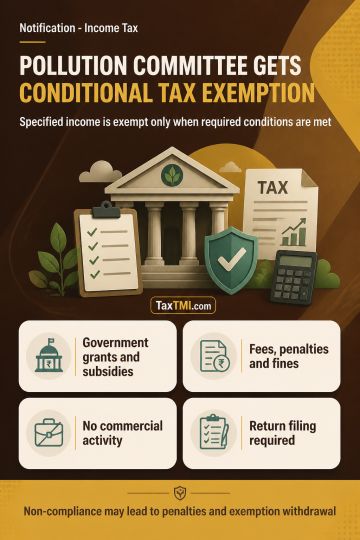
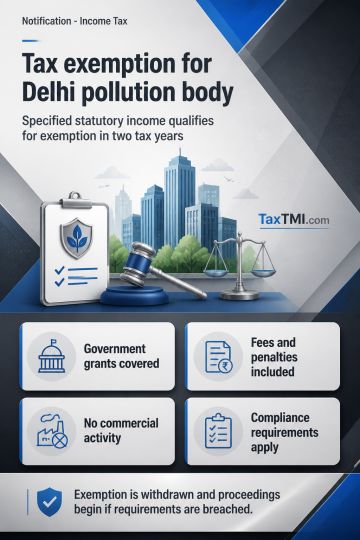
Specified income tax exemption for pollution control body remains conditional on non-commercial activity, unchanged income character, and return filin...
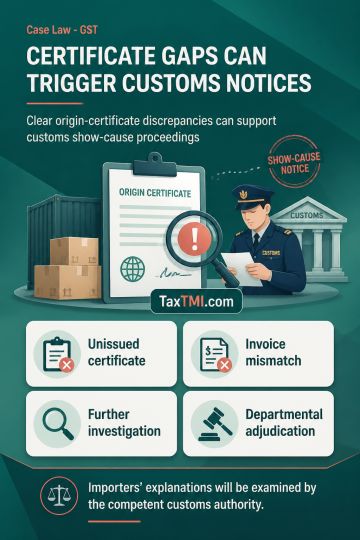
Jurisdictional facts in certificate-of-origin discrepancies can support customs show-cause proceedings, leaving factual explanations for departmental ...
Circular No. 19/2019 requires a Document Identification Number...
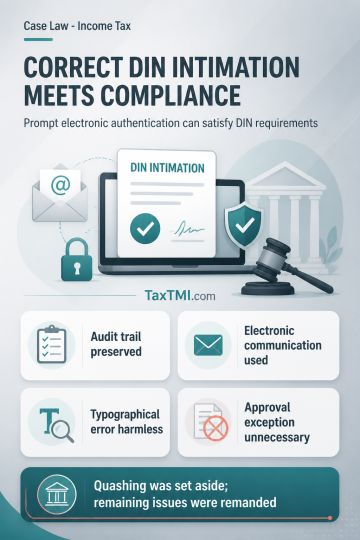
Document Identification Number compliance is satisfied when electronically communicated orders are promptly authenticated through a correctly identified subsequent DIN intimation.
Contents
Summary
Note
Bookmark
Share
✓ Copied successfully !
Print
Print Options
For full text, please login
Login to TaxTMI
Verification Pending
The Email Id has not been verified. Click on the link we have sent on
Circular No. 19/2019 requires a Document Identification Number (DIN) to ensure authenticity and an audit trail for departmental communications. Where manually prepared orders are uploaded for DIN generation, initially communicated electronically, and promptly followed by an intimation correctly stating the DIN assigned to the enclosed order, the procedure constitutes substantial compliance. The manual-communication exception requiring prior approval does not apply to such electronic communications. A typographical error entering the intimation letter's DIN instead of the order's DIN does not invalidate the order if the intimation correctly identifies the order and its DIN. The Tribunal's quashing of the DRP directions and revisional order was set aside, with remand for remaining issues.
Circular No. 19/2019 requires a Document Identification Number (DIN) to ensure authenticity and an audit trail for departmental communications. Where manually prepared orders are uploaded for DIN generation, initially communicated electronically, and promptly followed by an intimation correctly stating the DIN assigned to the enclosed order, the procedure constitutes substantial compliance. The manual-communication exception requiring prior approval does not apply to such electronic communications. A typographical error entering the intimation letter's DIN instead of the order's DIN does not invalidate the order if the intimation correctly identifies the order and its DIN. The Tribunal's quashing of the DRP directions and revisional order was set aside, with remand for remaining issues.
Note: It is a system-generated summary and is for quick reference only.
 TaxTMI
 of 4782






 Join Channel


 TaxTMI