Business expenditure deduction requires proof of genuine commission payments and commercial allowability; turnover growth alone cannot validate the cl...
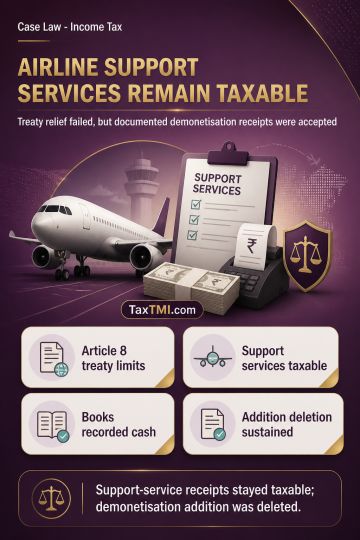
Article 8 treaty coverage excluded third-party airline support services, while documented demonetisation cash receipts remained accepted business inco...
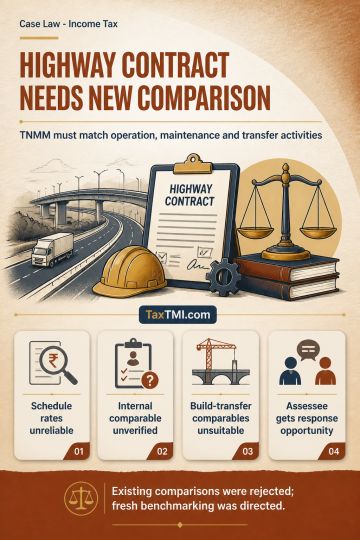
Functional comparability under TNMM requires highway contract benchmarks to reflect operation, maintenance and transfer activities, requiring fresh be...
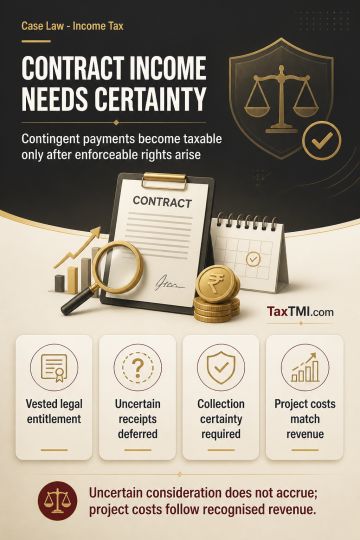
Under the mercantile system, contingent contractual consideration does not accrue merely because it is stated in an agreement; taxable income requires a vested, unconditional and enforceable right and a corresponding debt due. Where a contractual tranche depends on conditions, step-in rights and deductible costs, uncertainty over receipt and quantification prevents real income from accruing. Accounting Standard-9 requires reasonable certainty of ultimate collection, while later recovery proceedings may corroborate existing uncertainty. Under the percentage completion method, project expenditure carried in work-in-progress may be claimed when corresponding revenue is recognised, provided it relates to the project and is not deducted twice.
Under the mercantile system, contingent contractual consideration does not accrue merely because it is stated in an agreement; taxable income requires a vested, unconditional and enforceable right and a corresponding debt due. Where a contractual tranche depends on conditions, step-in rights and deductible costs, uncertainty over receipt and quantification prevents real income from accruing. Accounting Standard-9 requires reasonable certainty of ultimate collection, while later recovery proceedings may corroborate existing uncertainty. Under the percentage completion method, project expenditure carried in work-in-progress may be claimed when corresponding revenue is recognised, provided it relates to the project and is not deducted twice.
Note: It is a system-generated summary and is for quick reference only.
 TaxTMI
 of 4788







 Join Channel


 TaxTMI
