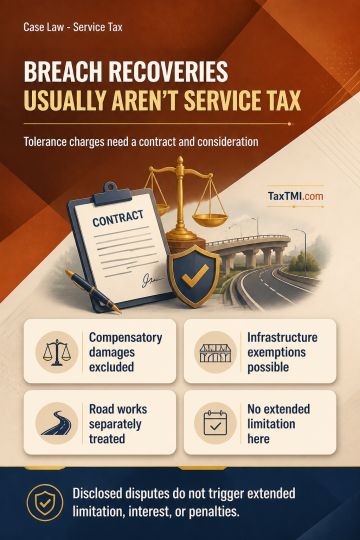
Contractual tolerance requires consideration; breach recoveries, qualifying public infrastructure services and road works escape service tax liability...
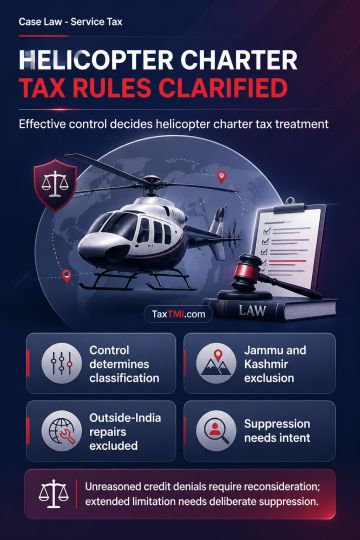
Helicopter charter classification requires effective control analysis, while territorial performance, reasoned credit orders and wilful suppression de...
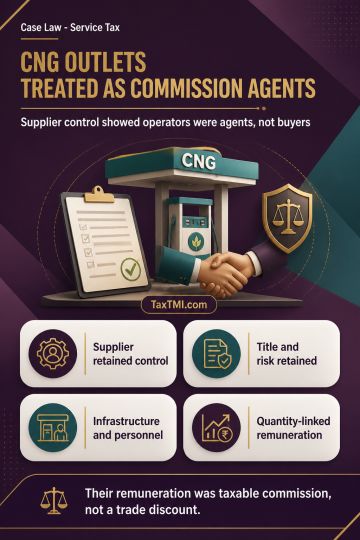
Agency in CNG distribution makes outlet operators commission agents, rendering taxable Business Auxiliary Service rather than purchasing goods for res...
Works contract classification governs composite layout-development contracts where VAT-paid goods are transferred alongside construction and infrastru...
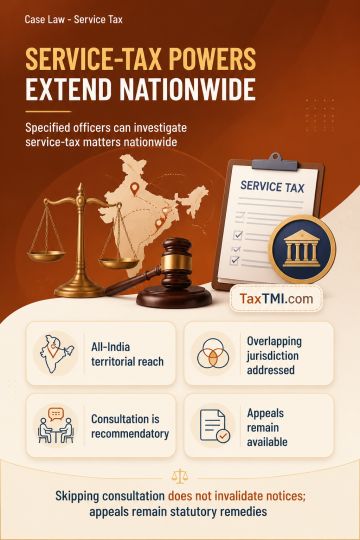
Pan-India jurisdiction of specified Central Excise Officers for service-tax investigations is examined through the meaning of "local limits" under the Service Tax Rules. The notes explain that the Board's power to appoint and invest officers under Chapter V of the Finance Act, 1994 can extend to all-India territorial limits, and that later notifications do not curtail independently conferred powers. They also address overlapping jurisdiction, requiring the specified adjudicating authority to proceed with the relevant show-cause notice. Pre-show-cause-notice consultation under the departmental Master Circular is described as recommendatory rather than mandatory, so its omission does not invalidate notices; factual challenges to original orders remain subject to statutory appellate remedies.
Pan-India jurisdiction of specified Central Excise Officers for service-tax investigations is examined through the meaning of "local limits" under the Service Tax Rules. The notes explain that the Board's power to appoint and invest officers under Chapter V of the Finance Act, 1994 can extend to all-India territorial limits, and that later notifications do not curtail independently conferred powers. They also address overlapping jurisdiction, requiring the specified adjudicating authority to proceed with the relevant show-cause notice. Pre-show-cause-notice consultation under the departmental Master Circular is described as recommendatory rather than mandatory, so its omission does not invalidate notices; factual challenges to original orders remain subject to statutory appellate remedies.
Note: It is a system-generated summary and is for quick reference only.
 TaxTMI













 Join Channel


 TaxTMI

