Allocation of registration charges: contractual clause overriding statutory presumption allowed as deduction against capital gain after unrebutted doc...
Expenditure tied to investments yielding exempt income restricted to attributable costs; broader disallowance disallowed and adjustments to WDV and mi...
Admissibility of Investigative Statements invalidated reliance on coerced emails and valuation redetermination, resulting in set aside of penalties an...
Classification of printed technical documents: specific Chapter 49.01 entry prevails, enabling claimed customs exemptions for imported manuals and rep...
Separate assessment orders for different assessment years may be...
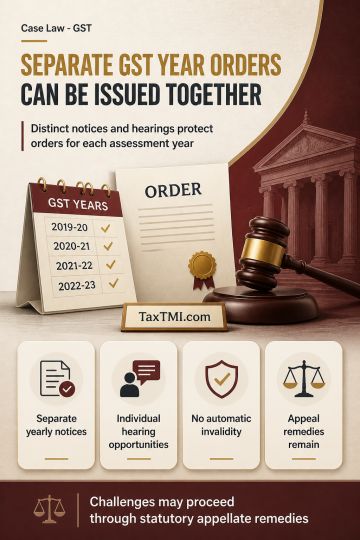
Separate assessment orders for different years remain valid when distinct notices and hearing opportunities prevent prejudice from combined proceedings
Contents
Summary
Note
Bookmark
Share
✓ Copied successfully !
Print
Print Options
For full text, please login
Login to TaxTMI
Verification Pending
The Email Id has not been verified. Click on the link we have sent on
Separate assessment orders for different assessment years may be issued simultaneously where each year is supported by a separate notice and separate opportunity to respond. The absence of a statutory prohibition means simultaneous issuance does not, by itself, invalidate the orders. The restriction on composite notices and common assessment orders is directed at preventing prejudice from combining proceedings across years, not at prohibiting coordinated issuance of distinct orders. Accordingly, simultaneous separate orders do not warrant interference, while substantive challenges remain subject to the available statutory appellate remedies.
Separate assessment orders for different assessment years may be issued simultaneously where each year is supported by a separate notice and separate opportunity to respond. The absence of a statutory prohibition means simultaneous issuance does not, by itself, invalidate the orders. The restriction on composite notices and common assessment orders is directed at preventing prejudice from combining proceedings across years, not at prohibiting coordinated issuance of distinct orders. Accordingly, simultaneous separate orders do not warrant interference, while substantive challenges remain subject to the available statutory appellate remedies.
Note: It is a system-generated summary and is for quick reference only.
 TaxTMI
  TaxTMI
 of 4823


 Join Channel