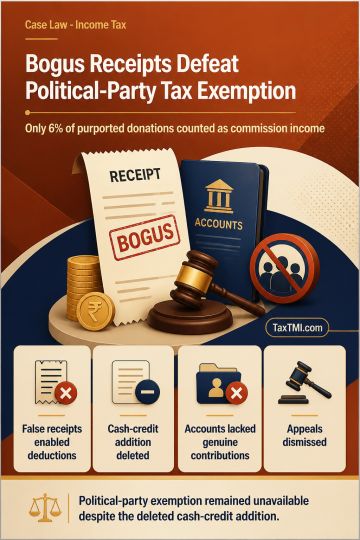
Bogus donation receipts justified commission income assessment and defeated political-party tax exemption for inaccurate accounts and reporting failur...
Pure reimbursement without income element escapes tax withholding, while delayed withholding and unsupported provisions face deferred or renewed scrut...
Public benefit requirement defeats charitable registration where residents' association services are reciprocal, member-only facilities governed by mu...
Exempt-income expenditure disallowance is confined to investments that actually generated exempt income, while supported business expenses remain dedu...
Objective characteristics and principal use govern mining-tyre classification, while fresh advance ruling applications may rely on additional technica...
Benami proceedings involving a fictitious-name transaction turn on cumulative evidence rather than the supplier's failure to file tax returns alone. The alleged supplier's absence from its stated address, unserved notices, inconsistent GST business description, untraceable bank account, and lack of credible proof of supply, delivery, payment, or accounting were identified as sufficient to discharge the initial burden; the appellants did not rebut it. The transaction was therefore treated as benami under Section 2(9)(B). In a fictitious transaction, the routed amount may be regarded as returning to the beneficial owner, permitting attachment in that owner's account rather than requiring attachment only from a benamidar. The provisional attachment and related findings were upheld.
Benami proceedings involving a fictitious-name transaction turn on cumulative evidence rather than the supplier's failure to file tax returns alone. The alleged supplier's absence from its stated address, unserved notices, inconsistent GST business description, untraceable bank account, and lack of credible proof of supply, delivery, payment, or accounting were identified as sufficient to discharge the initial burden; the appellants did not rebut it. The transaction was therefore treated as benami under Section 2(9)(B). In a fictitious transaction, the routed amount may be regarded as returning to the beneficial owner, permitting attachment in that owner's account rather than requiring attachment only from a benamidar. The provisional attachment and related findings were upheld.
Note: It is a system-generated summary and is for quick reference only.
 TaxTMI
 of 4790
















 Join Channel



 TaxTMI
