Development agreements require legal possession or effective enjoyment for capital gains transfer; permissive possession and deferred consideration de...
Prolonged sterilisation of development rights supports capital-gains treatment, while business-income disallowances cannot govern capital-gains comput...
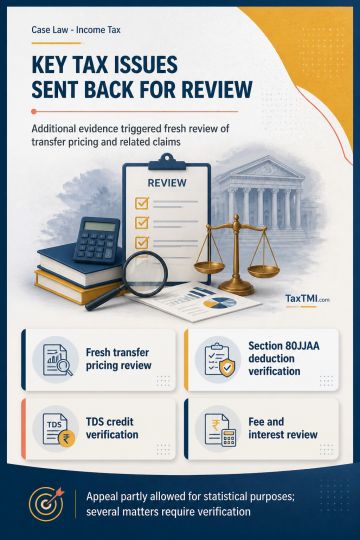
Additional evidence in transfer pricing dispute leads to fresh examination, while tax deductions, TDS credit, fee and refund interest require verifica...
Category II AIF pass-through taxation preserves non-business income character; investment receipts cannot be reclassified without applying recognised ...
Mutual fund maturity rules require proper rollover, redemption, disclosure, and due diligence; investor gains cannot excuse regulatory breaches or pen...
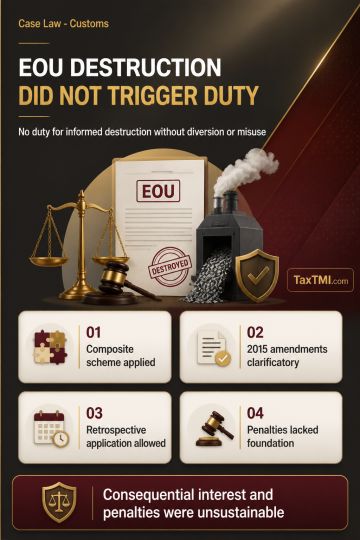
Destruction of obsolete or unusable duty-free inputs by a 100% Export Oriented Unit within its factory, after intimation to the department, did not attract Customs or Central Excise duty where there was no diversion or misuse. The Foreign Trade Policy, Development Commissioner permissions and exemption notifications were required to be read as a composite scheme, so the absence of an express pre-amendment notification provision could not create an artificial duty liability. Amendments made in 2015 expressly permitting such destruction were clarificatory and retrospective because they aligned the notifications with the pre-existing policy position. Consequential interest and penalties were unsustainable without suppression, wilful misstatement or intent to evade duty.
Destruction of obsolete or unusable duty-free inputs by a 100% Export Oriented Unit within its factory, after intimation to the department, did not attract Customs or Central Excise duty where there was no diversion or misuse. The Foreign Trade Policy, Development Commissioner permissions and exemption notifications were required to be read as a composite scheme, so the absence of an express pre-amendment notification provision could not create an artificial duty liability. Amendments made in 2015 expressly permitting such destruction were clarificatory and retrospective because they aligned the notifications with the pre-existing policy position. Consequential interest and penalties were unsustainable without suppression, wilful misstatement or intent to evade duty.
Note: It is a system-generated summary and is for quick reference only.
 TaxTMI
 of 4782
















 Join Channel


 TaxTMI