Cooperative society deposits, member-interest TDS exemption and credit-facility deduction claims require verification through records and supporting e...
Customs jurisdiction over EPCG condition breaches survives export-obligation discharge certificates, requiring alleged fraud and misdeclaration to be ...
Contractual tolerance requires consideration; breach recoveries, qualifying public infrastructure services and road works escape service tax liability...
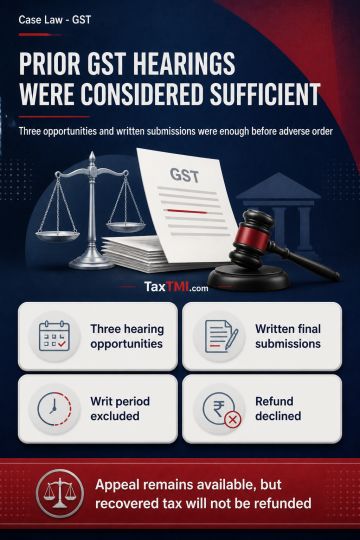
Personal hearing requirements in GST adjudication were satisfied by prior opportunities and written submissions; appellate limitation received writ-pe...
Page of 4786
Press 'Enter' after typing page number.
501 to 520 of 95714 Results
❮
❯
❯❯
0 / 200
Expand Note
Add to Folder
No Folders have been created
+
Are you sure you want to delete "My most important" ?
Destruction of obsolete or unusable duty-free inputs by a 100% Export Oriented Unit within its factory, after intimation to the department, did not attract Customs or Central Excise duty where there was no diversion or misuse. The Foreign Trade Policy, Development Commissioner permissions and exemption notifications were required to be read as a composite scheme, so the absence of an express pre-amendment notification provision could not create an artificial duty liability. Amendments made in 2015 expressly permitting such destruction were clarificatory and retrospective because they aligned the notifications with the pre-existing policy position. Consequential interest and penalties were unsustainable without suppression, wilful misstatement or intent to evade duty.
Destruction of obsolete or unusable duty-free inputs by a 100% Export Oriented Unit within its factory, after intimation to the department, did not attract Customs or Central Excise duty where there was no diversion or misuse. The Foreign Trade Policy, Development Commissioner permissions and exemption notifications were required to be read as a composite scheme, so the absence of an express pre-amendment notification provision could not create an artificial duty liability. Amendments made in 2015 expressly permitting such destruction were clarificatory and retrospective because they aligned the notifications with the pre-existing policy position. Consequential interest and penalties were unsustainable without suppression, wilful misstatement or intent to evade duty.
Note: It is a system-generated summary and is for quick reference only.
 TaxTMI
 of 4786


















 Join Channel



 TaxTMI