Development agreements require legal possession or effective enjoyment for capital gains transfer; permissive possession and deferred consideration de...
Prolonged sterilisation of development rights supports capital-gains treatment, while business-income disallowances cannot govern capital-gains comput...
Additional evidence in transfer pricing dispute leads to fresh examination, while tax deductions, TDS credit, fee and refund interest require verifica...
Category II AIF pass-through taxation preserves non-business income character; investment receipts cannot be reclassified without applying recognised ...
Mutual fund maturity rules require proper rollover, redemption, disclosure, and due diligence; investor gains cannot excuse regulatory breaches or pen...
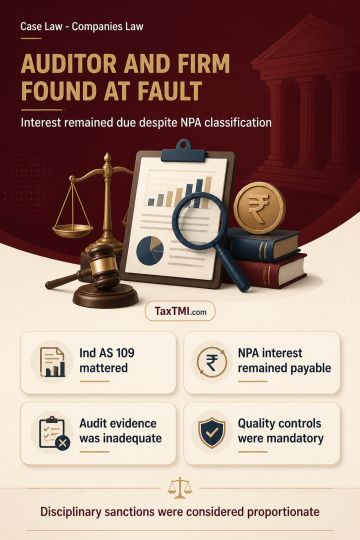
Non-recognition of interest on borrowings classified as NPAs was inconsistent with Ind AS 109 because RBI income-recognition norms for lenders did not extinguish the borrower's contractual liability, and an unaccepted, undocumented One-Time Settlement proposal could not replace contractual cash flows. Inadequate professional scepticism, audit evidence and documentation supported misconduct findings against the engagement partner, while the material and pervasive misstatement required consideration of a qualified or adverse opinion rather than an unmodified opinion. Engagement quality control review and applicable Standards on Auditing were mandatory for the listed-entity audit. The audit firm incurred independent quality-control liability under SQC 1; separate proceedings were not barred by double jeopardy, and the disciplinary sanctions were considered proportionate.
Non-recognition of interest on borrowings classified as NPAs was inconsistent with Ind AS 109 because RBI income-recognition norms for lenders did not extinguish the borrower's contractual liability, and an unaccepted, undocumented One-Time Settlement proposal could not replace contractual cash flows. Inadequate professional scepticism, audit evidence and documentation supported misconduct findings against the engagement partner, while the material and pervasive misstatement required consideration of a qualified or adverse opinion rather than an unmodified opinion. Engagement quality control review and applicable Standards on Auditing were mandatory for the listed-entity audit. The audit firm incurred independent quality-control liability under SQC 1; separate proceedings were not barred by double jeopardy, and the disciplinary sanctions were considered proportionate.
Note: It is a system-generated summary and is for quick reference only.
 TaxTMI
 of 4782



















 Join Channel


 TaxTMI