Development agreements require legal possession or effective enjoyment for capital gains transfer; permissive possession and deferred consideration de...
Prolonged sterilisation of development rights supports capital-gains treatment, while business-income disallowances cannot govern capital-gains comput...
Additional evidence in transfer pricing dispute leads to fresh examination, while tax deductions, TDS credit, fee and refund interest require verifica...
Category II AIF pass-through taxation preserves non-business income character; investment receipts cannot be reclassified without applying recognised ...
Mutual fund maturity rules require proper rollover, redemption, disclosure, and due diligence; investor gains cannot excuse regulatory breaches or pen...
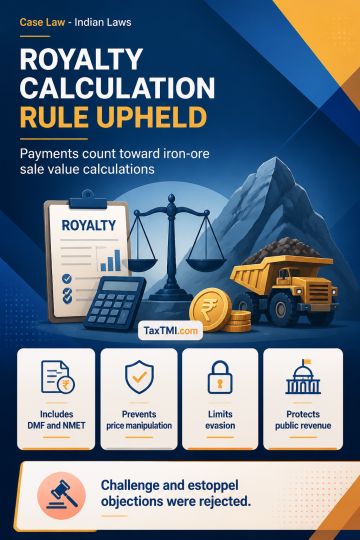
The notes address the constitutional validity of rules requiring royalty, DMF and NMET payments to be included in sale value when computing average sale price for iron-ore royalty. The measure is described as a computation mechanism, not a revision of the statutory royalty rate; accordingly, the three-year restriction on rate enhancement does not apply. Its stated purpose is to prevent manipulation of ex-mine prices and despatch data, curb evasion and protect public revenue. The challenge under Articles 14 and 19(1)(g), and under Section 9 of the MMDR Act, was rejected because the measure had a rational connection with the levy and was not manifestly arbitrary. The maintainability and estoppel objections were also rejected.
The notes address the constitutional validity of rules requiring royalty, DMF and NMET payments to be included in sale value when computing average sale price for iron-ore royalty. The measure is described as a computation mechanism, not a revision of the statutory royalty rate; accordingly, the three-year restriction on rate enhancement does not apply. Its stated purpose is to prevent manipulation of ex-mine prices and despatch data, curb evasion and protect public revenue. The challenge under Articles 14 and 19(1)(g), and under Section 9 of the MMDR Act, was rejected because the measure had a rational connection with the levy and was not manifestly arbitrary. The maintainability and estoppel objections were also rejected.
Note: It is a system-generated summary and is for quick reference only.
 TaxTMI
 of 4782





















 Join Channel


 TaxTMI