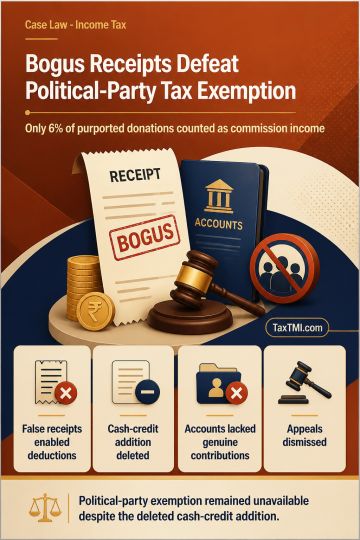
Bogus donation receipts justified commission income assessment and defeated political-party tax exemption for inaccurate accounts and reporting failur...
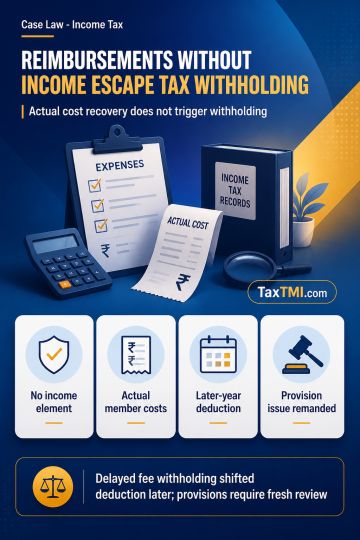
Pure reimbursement without income element escapes tax withholding, while delayed withholding and unsupported provisions face deferred or renewed scrut...
Public benefit requirement defeats charitable registration where residents' association services are reciprocal, member-only facilities governed by mu...
Exempt-income expenditure disallowance is confined to investments that actually generated exempt income, while supported business expenses remain dedu...
Objective characteristics and principal use govern mining-tyre classification, while fresh advance ruling applications may rely on additional technica...
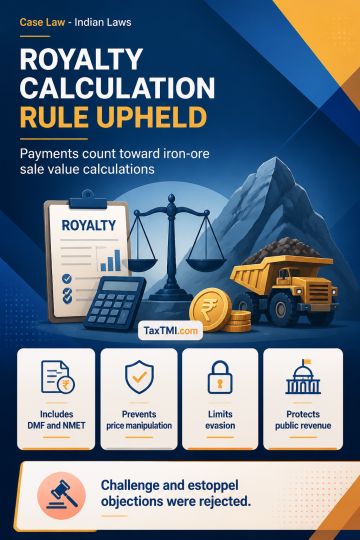
The notes address the constitutional validity of rules requiring royalty, DMF and NMET payments to be included in sale value when computing average sale price for iron-ore royalty. The measure is described as a computation mechanism, not a revision of the statutory royalty rate; accordingly, the three-year restriction on rate enhancement does not apply. Its stated purpose is to prevent manipulation of ex-mine prices and despatch data, curb evasion and protect public revenue. The challenge under Articles 14 and 19(1)(g), and under Section 9 of the MMDR Act, was rejected because the measure had a rational connection with the levy and was not manifestly arbitrary. The maintainability and estoppel objections were also rejected.
The notes address the constitutional validity of rules requiring royalty, DMF and NMET payments to be included in sale value when computing average sale price for iron-ore royalty. The measure is described as a computation mechanism, not a revision of the statutory royalty rate; accordingly, the three-year restriction on rate enhancement does not apply. Its stated purpose is to prevent manipulation of ex-mine prices and despatch data, curb evasion and protect public revenue. The challenge under Articles 14 and 19(1)(g), and under Section 9 of the MMDR Act, was rejected because the measure had a rational connection with the levy and was not manifestly arbitrary. The maintainability and estoppel objections were also rejected.
Note: It is a system-generated summary and is for quick reference only.
 TaxTMI
 of 4788














 Join Channel


 TaxTMI