Just a moment...

Top
Help
×

By creating an account you can:

Logo TaxTMI
>
Call Us / Help / Feedback

Contact Us At :

E-mail: [email protected]

Call / WhatsApp at: +91 99117 96707

For more information, Check Contact Us

FAQs :

To know Frequently Asked Questions, Check FAQs

Most Asked Video Tutorials :

For more tutorials, Check Video Tutorials

Submit Feedback/Suggestion :

Email :
Please provide your email address so we can follow up on your feedback.
Category :
Description :
Min 15 characters0/2000
Add to...
You have not created any category. Kindly create one to bookmark this item!
Create New Category
Hide
Title :
Description :
❮❮ Hide
Default View
Expand ❯❯
Close ✕
🔎 Highlights - Adv. Search
TEXT SEARCH:

Press 'Enter' to add multiple search terms. Rules for Better Search

Search In:
Main Text + AI Text
  • Main Text
  • Main Text + AI Text
  • AI Text
Law:
---- All Laws----
  • ---- All Laws----
  • Income Tax
  • Direct Taxes
  • Benami Property
  • Central GST Laws
  • SGST - State GST Laws
  • Customs
  • FTP - Foreign Trade Policy
  • SEZ - Special Economic Zone
  • FEMA - Foreign Exchange Management
  • Companies Law
  • SEBI - Securities & Exchange Board of India
  • IBC - Insolvency and Bankruptcy
  • Law of Competition
  • PMLA - Money-Laundering
  • Indian Laws
  • Bill / Finance Bills
  • Wealth Tax
  • Service Tax
  • Central Excise
  • VAT / Sales Tax
Month:
---- All Months ----
  • ---- All Months ----
  • January
  • February
  • March
  • April
  • May
  • June
  • July
  • August
  • September
  • October
  • November
  • December
Year:
---- All Years ----
  • ---- All Years ----
  • 2026
  • 2025
  • 2024
  • 2023
  • 2022
  • 2021
  • 2020
  • 2019
  • 2018
  • 2017
  • 2016
  • 2015
  • 2014
  • 2013
  • 2012
  • 2011
Sort By: ?
In Sort By 'Default', exact matches for text search are shown at the top, followed by the remaining results in their regular order.
RelevanceDefaultDate
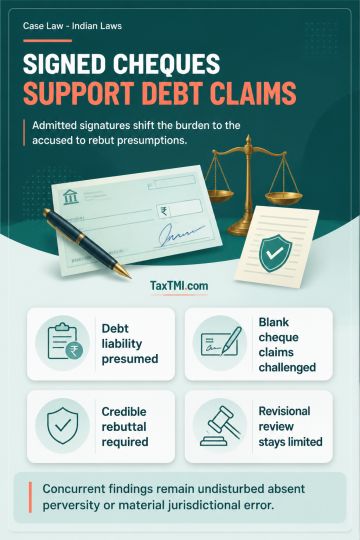
    Admitted cheque signatures raise debt presumptions, while revisional courts cannot reassess concurrent evidence without material jurisdictional error.
    Vicarious cheque dishonour liability cannot arise from family ties where the accused neither drew nor maintained the account.
    Post-award interim protection remains available to unsuccessful arbitral parties, subject to a higher threshold for exceptional relief.
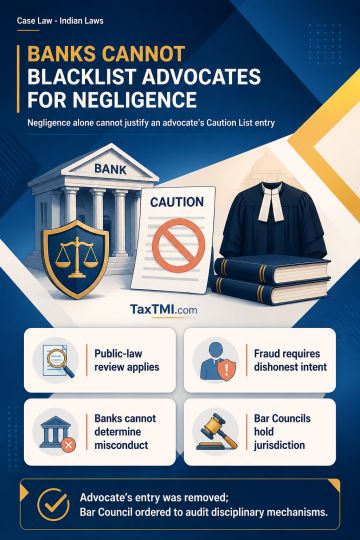
    Public-law scrutiny of banking fraud caution lists bars blacklisting advocates for alleged negligence without fraud or disciplinary process.
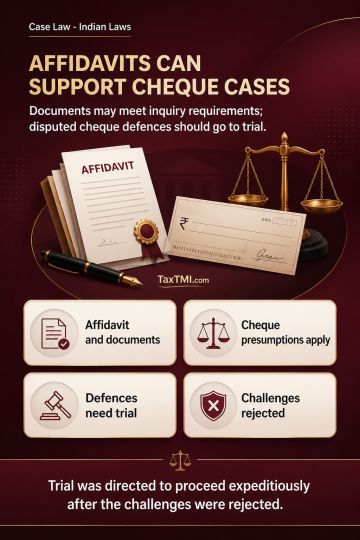
    Mandatory pre-summoning inquiry may be met by affidavit and documents; cheque-liability presumptions require disputed defences to face trial.
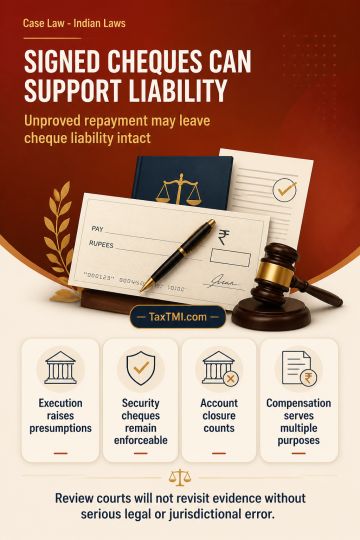
    Cheque execution presumptions sustain liability where repayment remains unproved, including for security cheques and account-closed dishonour.
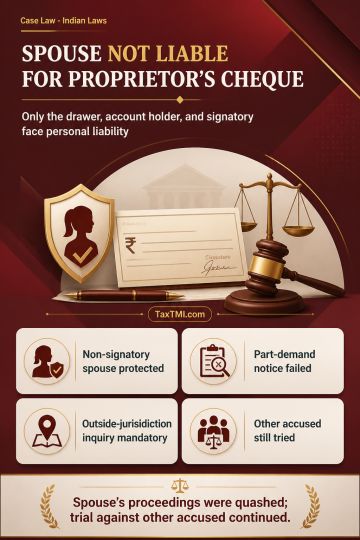
    Cheque-dishonour liability remains personal: non-signatory spouse cannot be vicariously prosecuted for a sole proprietorship's dishonoured cheque.
    Payee or holder status governs cheque-dishonour complaints; proceedings by an unauthorised deceased payee's heir were quashed.
    Statutory limits on Facilitation Council membership can render an arbitral award void and permit exceptional writ review.
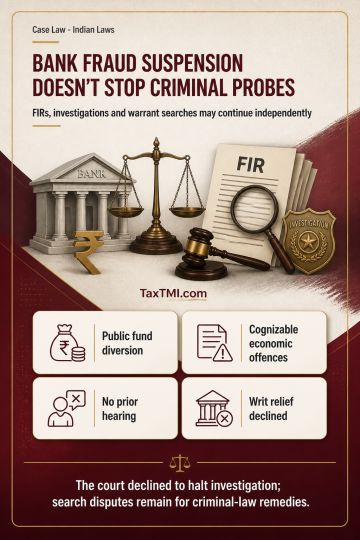
    Administrative fraud classification suspension does not halt independent criminal investigation or warrant-based searches into alleged economic offenc...
    Stamp duty on mining leases may rest on anticipated royalty where extraction value is indeterminate at execution.
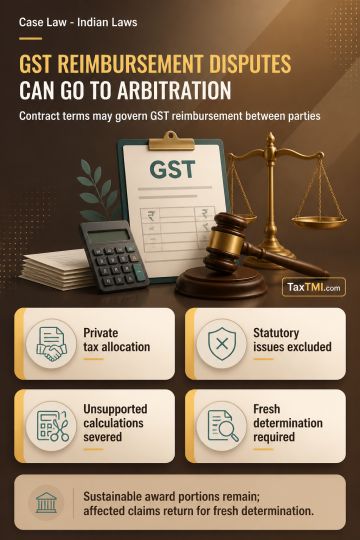
    Contractual GST reimbursement arbitration remains valid, but unsupported tax calculations may be severed and remitted for fresh determination.
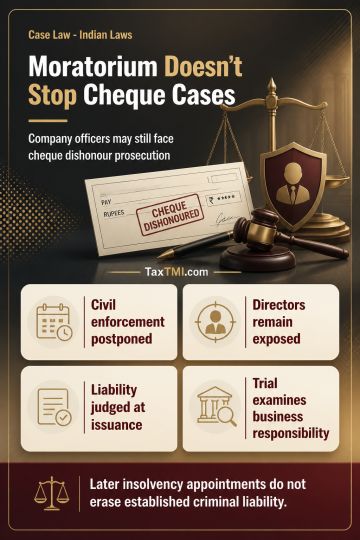
    Insolvency moratorium does not shield company officers from cheque dishonour prosecution for liability arising before corporate insolvency proceedings...
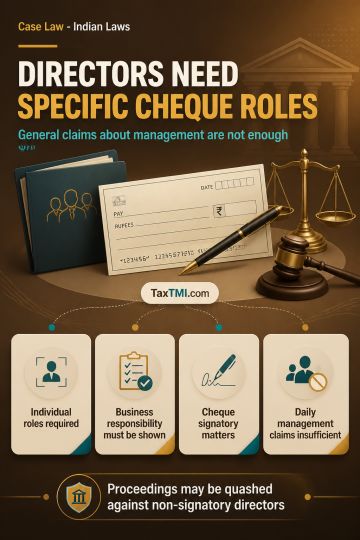
    Vicarious liability for cheque dishonour requires specific allegations linking each director to the company's business and transaction.
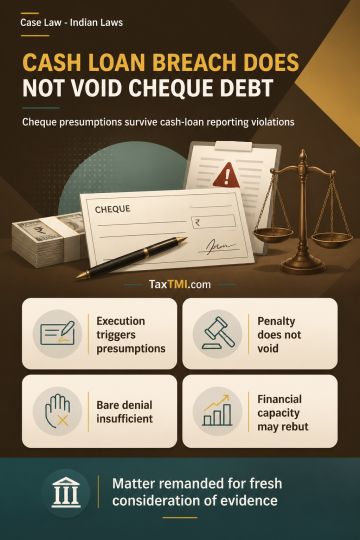
    Cheque dishonour presumptions survive cash-loan reporting breaches, while rebuttal requires more than a bare denial of liability.
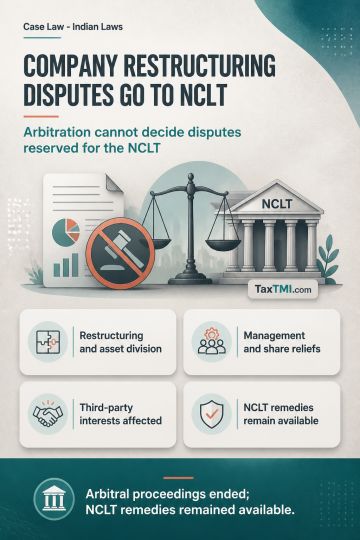
    Non-arbitrability of company restructuring disputes requires NCLT adjudication, permitting supervisory intervention and ending arbitration concerning ...
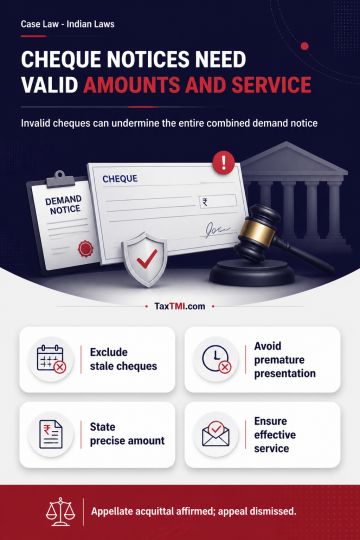
    Statutory demand notice must exclude stale or prematurely presented cheques and require valid service for cheque dishonour prosecution.
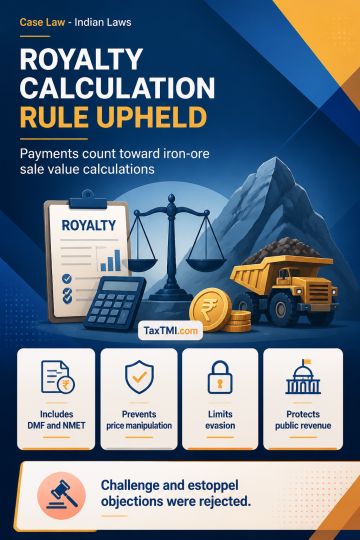
    Anti-evasion computation of royalty, DMF and NMET in sale value upheld; three-year royalty-rate revision limit does not apply
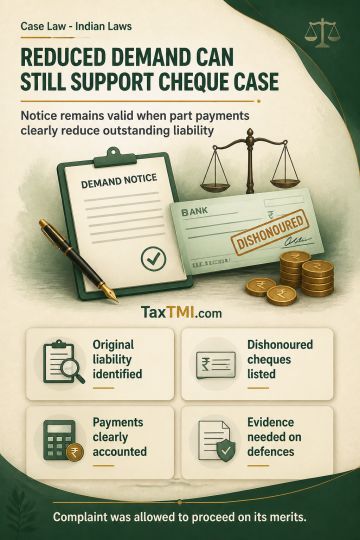
    Reduced cheque demand after part payments does not invalidate statutory notice where liability and balance are clearly explained
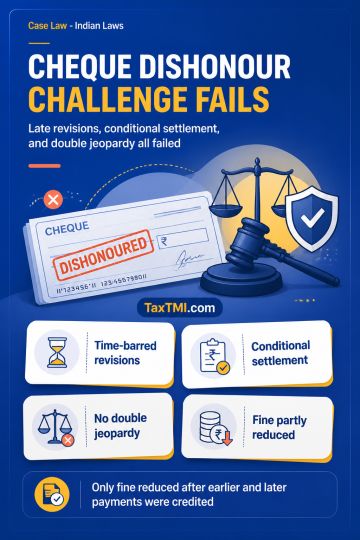
    Inordinate delay, conditional settlement and double jeopardy fail in cheque dishonour challenge; fine reduced for later payment credit
❯❯
MaximizeMaximizeMaximize
0 / 200
Expand Note
Add to Folder

No Folders have been created

    +

    Are you sure you want to delete "My most important" ?

    NOTE:

    Highlights
    Showing Results for :
    Reset Filters
    Results Found:
    Show All SummariesHide All Summaries

    Highlights

    Back

    All Highlights

    Showing Results for :
    Reset Filters
      No Records Found

      Highlights

      Back

      All Highlights

      whatsappJoin Channel
      Showing Results for : Reset Filters

      The notes address the constitutional validity of rules requiring...

      Anti-evasion computation of royalty, DMF and NMET in sale value upheld; three-year royalty-rate revision limit does not apply

      Contents
      Summary
      Note

      Note

      -

      Bookmark

      Print

      Print

      Indian LawsJuly 15, 2026Case LawsSC
      The notes address the constitutional validity of rules requiring royalty, DMF and NMET payments to be included in sale value when computing average sale price for iron-ore royalty. The measure is described as a computation mechanism, not a revision of the statutory royalty rate; accordingly, the three-year restriction on rate enhancement does not apply. Its stated purpose is to prevent manipulation of ex-mine prices and despatch data, curb evasion and protect public revenue. The challenge under Articles 14 and 19(1)(g), and under Section 9 of the MMDR Act, was rejected because the measure had a rational connection with the levy and was not manifestly arbitrary. The maintainability and estoppel objections were also rejected.

      Topics

      ActsIncome Tax