Defined public benefit can retain charitable character; registration renewal requires examining genuine activities and legal compliance, not surplus a...
Capital reduction is distinct from share buy-back, preventing buy-back tax; restructuring interest and related business deductions also survive scruti...
Transfer pricing and tax deductions upheld on established principles, while employee contributions and warranty provisions returned for fresh examinat...
Captive transfer pricing relies on industrial consumer tariffs, while genuine quotations can benchmark effluent treatment transfers under the Other Me...
Specific tariff classification for ophthalmic instruments and extended limitation principles determine the treatment of duty demands, confiscation, an...
Integrated golf function determines classification, placing launch monitors and simulators under other golf equipment rather than measuring instrument...
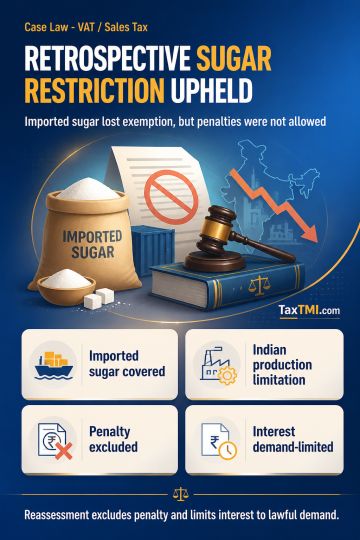
The pre-2001 Karnataka sales tax exemption for sugar covered imported sugar because the reference to the Additional Duties of Excise Act identified the commodity without imposing an origin-based limitation. The 2001 amendment restricting the exemption to sugar produced or manufactured in India was substantive and retrospective, but remained within legislative competence and was constitutionally valid. Retrospective taxation could determine the principal tax liability, while penalty was unavailable for transactions previously treated as exempt and interest could apply only from the lawful reassessment demand. Inter-State sales remained governed by the Central Sales Tax Act, including its applicable rate and conditions, requiring recomputation for the relevant period.
The pre-2001 Karnataka sales tax exemption for sugar covered imported sugar because the reference to the Additional Duties of Excise Act identified the commodity without imposing an origin-based limitation. The 2001 amendment restricting the exemption to sugar produced or manufactured in India was substantive and retrospective, but remained within legislative competence and was constitutionally valid. Retrospective taxation could determine the principal tax liability, while penalty was unavailable for transactions previously treated as exempt and interest could apply only from the lawful reassessment demand. Inter-State sales remained governed by the Central Sales Tax Act, including its applicable rate and conditions, requiring recomputation for the relevant period.
Note: It is a system-generated summary and is for quick reference only.
 TaxTMI
 of 4782




















 Join Channel


 TaxTMI
