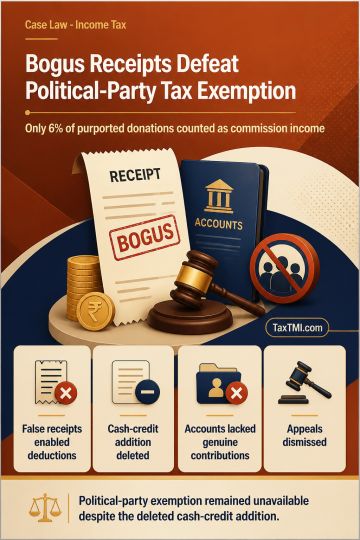
Bogus donation receipts justified commission income assessment and defeated political-party tax exemption for inaccurate accounts and reporting failur...
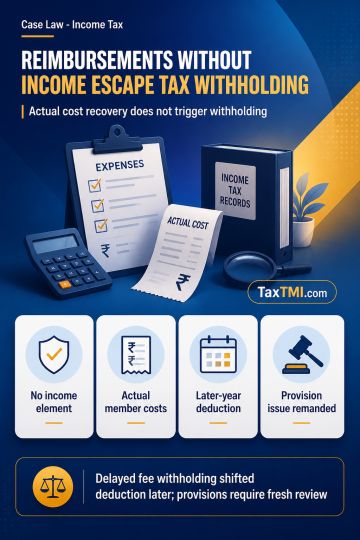
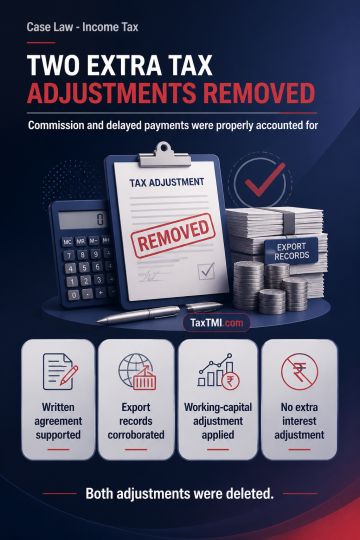
Pure reimbursement without income element escapes tax withholding, while delayed withholding and unsupported provisions face deferred or renewed scrut...
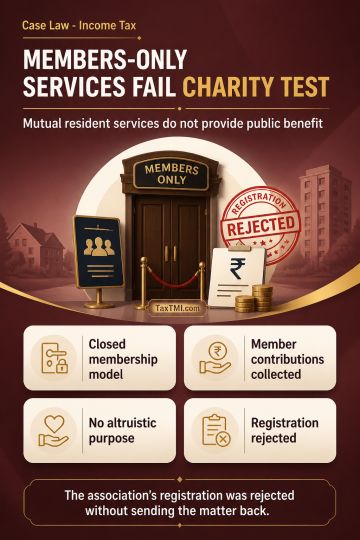
Public benefit requirement defeats charitable registration where residents' association services are reciprocal, member-only facilities governed by mu...
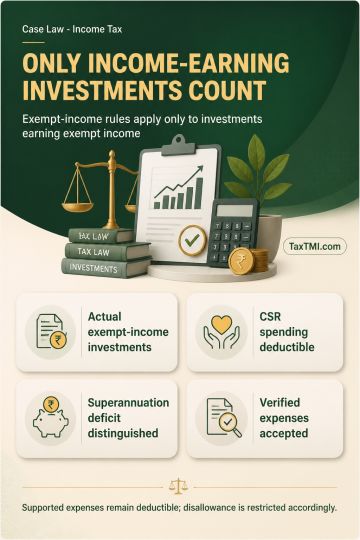
Exempt-income expenditure disallowance is confined to investments that actually generated exempt income, while supported business expenses remain dedu...
Objective characteristics and principal use govern mining-tyre classification, while fresh advance ruling applications may rely on additional technica...
Page of 4788
Press 'Enter' after typing page number.
461 to 480 of 95752 Results
❮
❯
❯❯
0 / 200
Expand Note
Add to Folder
No Folders have been created
+
Are you sure you want to delete "My most important" ?
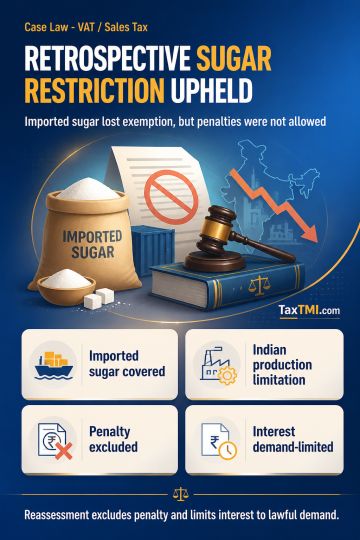
The pre-2001 Karnataka sales tax exemption for sugar covered imported sugar because the reference to the Additional Duties of Excise Act identified the commodity without imposing an origin-based limitation. The 2001 amendment restricting the exemption to sugar produced or manufactured in India was substantive and retrospective, but remained within legislative competence and was constitutionally valid. Retrospective taxation could determine the principal tax liability, while penalty was unavailable for transactions previously treated as exempt and interest could apply only from the lawful reassessment demand. Inter-State sales remained governed by the Central Sales Tax Act, including its applicable rate and conditions, requiring recomputation for the relevant period.
The pre-2001 Karnataka sales tax exemption for sugar covered imported sugar because the reference to the Additional Duties of Excise Act identified the commodity without imposing an origin-based limitation. The 2001 amendment restricting the exemption to sugar produced or manufactured in India was substantive and retrospective, but remained within legislative competence and was constitutionally valid. Retrospective taxation could determine the principal tax liability, while penalty was unavailable for transactions previously treated as exempt and interest could apply only from the lawful reassessment demand. Inter-State sales remained governed by the Central Sales Tax Act, including its applicable rate and conditions, requiring recomputation for the relevant period.
Note: It is a system-generated summary and is for quick reference only.
 TaxTMI
 of 4788




 Join Channel


 TaxTMI