Condonation of Delay: directoral disputes and pending company proceedings can constitute reasonable cause, allowing a belated return to be treated as ...
Revisionary jurisdiction under section 263 upheld; faceless assessments subject to revision when AO fails requisite enquiries, remitted for fresh asse...
Limited scope of processing under section 143(1): enhancement without show cause is unsustainable; remand for residency, taxation and TDS verification...
Page of 4826
Press 'Enter' after typing page number.
5441 to 5460 of 96510 Results
❮
❯
❯❯
0 / 200
Expand Note
Add to Folder
No Folders have been created
+
Are you sure you want to delete "My most important" ?
A development agreement does not necessarily constitute a...
Development agreements require legal possession or effective enjoyment for capital gains transfer; permissive possession and deferred consideration defer taxation.
Contents
Summary
Note
Bookmark
Share
✓ Copied successfully !
Print
Print Options
For full text, please login
Login to TaxTMI
Verification Pending
The Email Id has not been verified. Click on the link we have sent on
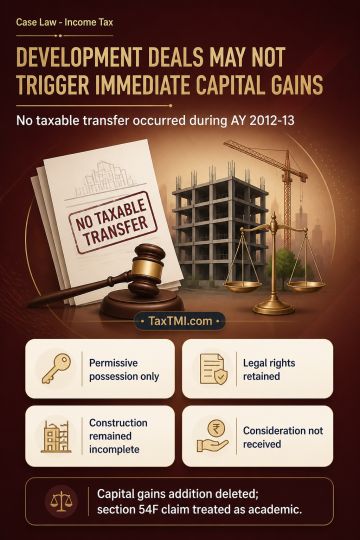
A development agreement does not necessarily constitute a transfer of immovable property under sections 2(47)(v) or 2(47)(vi) where possession is merely permissive, legal rights remain with the landowner, construction is incomplete, and consideration is not received during the relevant year. Applying the section 53A part-performance standard and the real income principle, the Tribunal's reasoning was that no legal possession, enjoyment, or income had accrued to the assessee in AY 2012-13. Accordingly, no transfer of the capital asset occurred and capital gains were not chargeable for that year. The capital gains addition was deleted, while the section 54F deduction claim was treated as academic.
A development agreement does not necessarily constitute a transfer of immovable property under sections 2(47)(v) or 2(47)(vi) where possession is merely permissive, legal rights remain with the landowner, construction is incomplete, and consideration is not received during the relevant year. Applying the section 53A part-performance standard and the real income principle, the Tribunal's reasoning was that no legal possession, enjoyment, or income had accrued to the assessee in AY 2012-13. Accordingly, no transfer of the capital asset occurred and capital gains were not chargeable for that year. The capital gains addition was deleted, while the section 54F deduction claim was treated as academic.
Note: It is a system-generated summary and is for quick reference only.
 TaxTMI
  TaxTMI
 of 4826


 Join Channel