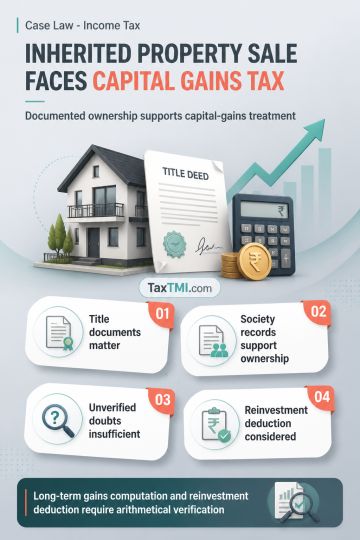
Inherited property sale proceeds require capital-gains treatment where ownership is supported by evidence, not suspicion or unverified signature doubt...
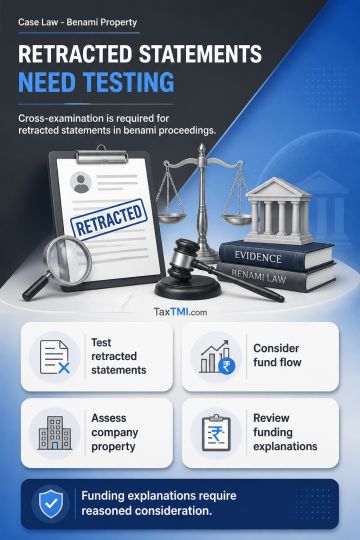
Cross-examination of retracted statements is essential where foundational evidence supports a benami allegation and documented funding explanations re...
Capital-goods exemption covers plant-modernisation accessories, while the import restriction applies only to earlier capital-goods components and spar...
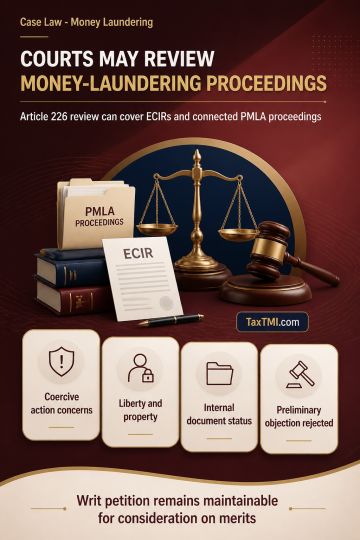
Constitutional judicial review permits challenges to ECIRs and connected money-laundering proceedings where coercive action affects fundamental intere...
A development agreement does not necessarily constitute a...
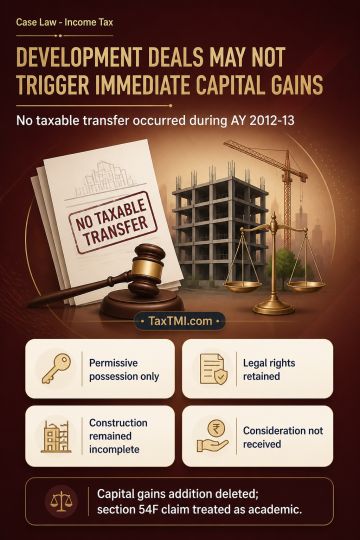
Development agreements require legal possession or effective enjoyment for capital gains transfer; permissive possession and deferred consideration defer taxation.
Contents
Summary
Note
Bookmark
Share
✓ Copied successfully !
Print
Print Options
For full text, please login
Login to TaxTMI
Verification Pending
The Email Id has not been verified. Click on the link we have sent on
A development agreement does not necessarily constitute a transfer of immovable property under sections 2(47)(v) or 2(47)(vi) where possession is merely permissive, legal rights remain with the landowner, construction is incomplete, and consideration is not received during the relevant year. Applying the section 53A part-performance standard and the real income principle, the Tribunal's reasoning was that no legal possession, enjoyment, or income had accrued to the assessee in AY 2012-13. Accordingly, no transfer of the capital asset occurred and capital gains were not chargeable for that year. The capital gains addition was deleted, while the section 54F deduction claim was treated as academic.
A development agreement does not necessarily constitute a transfer of immovable property under sections 2(47)(v) or 2(47)(vi) where possession is merely permissive, legal rights remain with the landowner, construction is incomplete, and consideration is not received during the relevant year. Applying the section 53A part-performance standard and the real income principle, the Tribunal's reasoning was that no legal possession, enjoyment, or income had accrued to the assessee in AY 2012-13. Accordingly, no transfer of the capital asset occurred and capital gains were not chargeable for that year. The capital gains addition was deleted, while the section 54F deduction claim was treated as academic.
Note: It is a system-generated summary and is for quick reference only.
 TaxTMI
 of 4792














 Join Channel


 TaxTMI