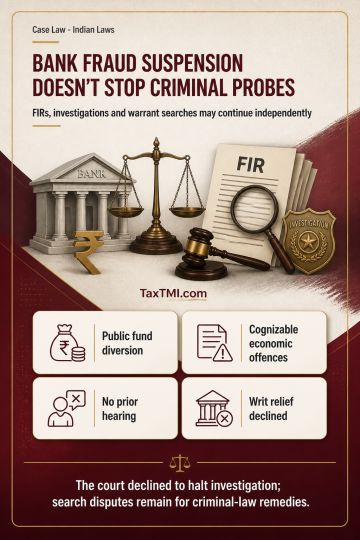
Administrative fraud classification suspension does not halt independent criminal investigation or warrant-based searches into alleged economic offenc...
Arrest safeguards and transit remand requirements invalidated detention following inter-State transfer without communicated grounds or magistrate auth...
Page of 4788
Press 'Enter' after typing page number.
481 to 500 of 95752 Results
❮
❯
❯❯
0 / 200
Expand Note
Add to Folder
No Folders have been created
+
Are you sure you want to delete "My most important" ?
Mutual fund regulations require asset management companies to...
Mutual fund maturity rules require proper rollover, redemption, disclosure, and due diligence; investor gains cannot excuse regulatory breaches or penalties
Contents
Summary
Note
Bookmark
Share
✓ Copied successfully !
Print
Print Options
For full text, please login
Login to TaxTMI
Verification Pending
The Email Id has not been verified. Click on the link we have sent on
Mutual fund regulations require asset management companies to conduct documented due diligence addressing relevant credit, liquidity and interest-rate risks; eventual investor gains do not cure non-compliance. Close-ended schemes must be fully redeemed and wound up at maturity unless a prescribed rollover, including required disclosure and consent, is completed. Extending underlying debenture maturities and effecting only partial redemption therefore breaches the regulatory framework, and similar market conduct, absence of investor complaints, or investor benefit provides no defence. Trustees must independently oversee compliance and protect unitholder interests, while adequate disclosures to unitholders and the regulator are required. Securities-law penalties for established civil contraventions do not depend on mens rea, and senior executives may remain liable where their expertise and conduct contributed to the breach.
Mutual fund regulations require asset management companies to conduct documented due diligence addressing relevant credit, liquidity and interest-rate risks; eventual investor gains do not cure non-compliance. Close-ended schemes must be fully redeemed and wound up at maturity unless a prescribed rollover, including required disclosure and consent, is completed. Extending underlying debenture maturities and effecting only partial redemption therefore breaches the regulatory framework, and similar market conduct, absence of investor complaints, or investor benefit provides no defence. Trustees must independently oversee compliance and protect unitholder interests, while adequate disclosures to unitholders and the regulator are required. Securities-law penalties for established civil contraventions do not depend on mens rea, and senior executives may remain liable where their expertise and conduct contributed to the breach.
Note: It is a system-generated summary and is for quick reference only.
 TaxTMI
 of 4788














 Join Channel



 TaxTMI

