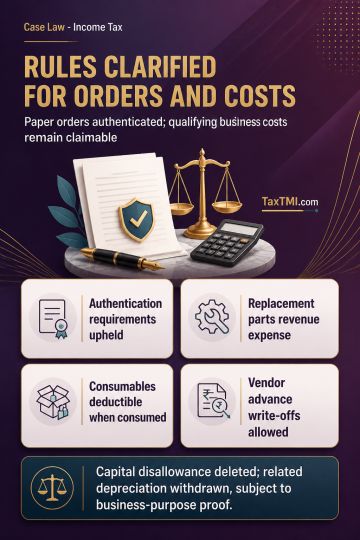
Authentication of paper assessment orders upheld, while qualifying repairs, consumables and vendor advance write-offs remain deductible business claim...
Transaction value cannot be rejected solely on non-statutory valuation guidelines without corroborative evidence supporting reassessment of final cust...
Cross-examination rights and corroborated evidence limit customs penalties for misdeclaration in genuine import transactions involving documented clea...
Tariff classification of vehicle gear components follows the specific gearing entry, displacing motor-vehicle parts classification and related liabili...
Necessary-party requirements limit impleadment of independent entities, while deferred consideration does not create an appealable adverse determinati...
Page of 4789
Press 'Enter' after typing page number.
441 to 460 of 95769 Results
❮
❯
❯❯
0 / 200
Expand Note
Add to Folder
No Folders have been created
+
Are you sure you want to delete "My most important" ?
Mutual fund regulations require asset management companies to...
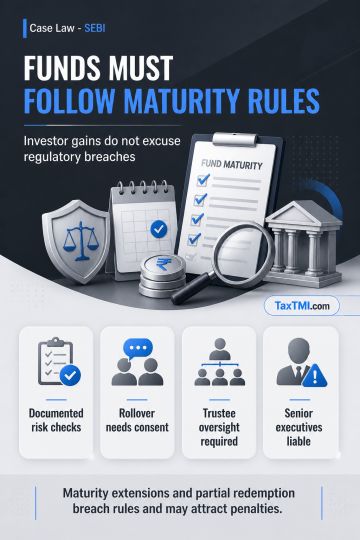
Mutual fund maturity rules require proper rollover, redemption, disclosure, and due diligence; investor gains cannot excuse regulatory breaches or penalties
Contents
Summary
Note
Bookmark
Share
✓ Copied successfully !
Print
Print Options
For full text, please login
Login to TaxTMI
Verification Pending
The Email Id has not been verified. Click on the link we have sent on
Mutual fund regulations require asset management companies to conduct documented due diligence addressing relevant credit, liquidity and interest-rate risks; eventual investor gains do not cure non-compliance. Close-ended schemes must be fully redeemed and wound up at maturity unless a prescribed rollover, including required disclosure and consent, is completed. Extending underlying debenture maturities and effecting only partial redemption therefore breaches the regulatory framework, and similar market conduct, absence of investor complaints, or investor benefit provides no defence. Trustees must independently oversee compliance and protect unitholder interests, while adequate disclosures to unitholders and the regulator are required. Securities-law penalties for established civil contraventions do not depend on mens rea, and senior executives may remain liable where their expertise and conduct contributed to the breach.
Mutual fund regulations require asset management companies to conduct documented due diligence addressing relevant credit, liquidity and interest-rate risks; eventual investor gains do not cure non-compliance. Close-ended schemes must be fully redeemed and wound up at maturity unless a prescribed rollover, including required disclosure and consent, is completed. Extending underlying debenture maturities and effecting only partial redemption therefore breaches the regulatory framework, and similar market conduct, absence of investor complaints, or investor benefit provides no defence. Trustees must independently oversee compliance and protect unitholder interests, while adequate disclosures to unitholders and the regulator are required. Securities-law penalties for established civil contraventions do not depend on mens rea, and senior executives may remain liable where their expertise and conduct contributed to the breach.
Note: It is a system-generated summary and is for quick reference only.
 TaxTMI
 of 4789


















 Join Channel


 TaxTMI

