Invoice-based recovery claims remain time-barred despite separate winding-up proceedings, absent valid acknowledgment or part-payment of the disputed ...
Extended limitation fails without specific suppression allegations, while overseas employee secondment remains taxable as manpower supply within norma...
Time-share accommodation classification excludes Club or Association Service where purchasers receive contractual occupancy rights without genuine mem...
CENVAT credit for trading requires reversal, while taxable-service rental credit remains proportionately available and limitation issues await resolut...
Vicarious liability for dishonoured company cheques may extend to non-signatory directors where complaints contain foundational responsibility avermen...
Page of 4794
Press 'Enter' after typing page number.
101 to 120 of 95872 Results
❮
❯
❯❯
0 / 200
Expand Note
Add to Folder
No Folders have been created
+
Are you sure you want to delete "My most important" ?
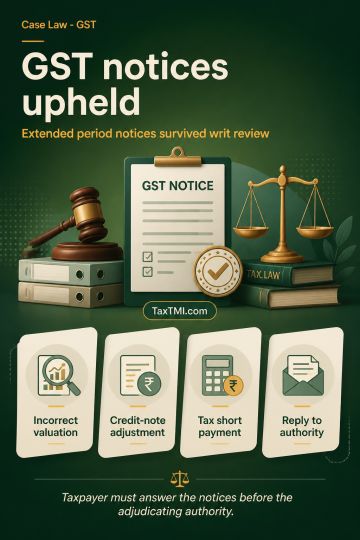
Foundational facts supported invocation of the extended period under GST Section 74, because the notices set out detailed allegations of incorrect valuation, inadmissible credit-note adjustment and short payment of tax, backed by investigation material and prior intimation; the writ challenge was therefore rejected as the disputed factual issues were not fit for writ review. Prior audit and earlier investigation did not defeat jurisdiction, because audit under Section 65 is distinct from a pan-India DGGI investigation, and overlap alone did not invalidate notices where separate grounds of evasion were alleged. The proceedings were held maintainable and the taxpayer was directed to reply before the adjudicating authority.
Foundational facts supported invocation of the extended period under GST Section 74, because the notices set out detailed allegations of incorrect valuation, inadmissible credit-note adjustment and short payment of tax, backed by investigation material and prior intimation; the writ challenge was therefore rejected as the disputed factual issues were not fit for writ review. Prior audit and earlier investigation did not defeat jurisdiction, because audit under Section 65 is distinct from a pan-India DGGI investigation, and overlap alone did not invalidate notices where separate grounds of evasion were alleged. The proceedings were held maintainable and the taxpayer was directed to reply before the adjudicating authority.
Note: It is a system-generated summary and is for quick reference only.
 TaxTMI
 of 4794

















 Join Channel


 TaxTMI

