Development agreements require legal possession or effective enjoyment for capital gains transfer; permissive possession and deferred consideration de...
Prolonged sterilisation of development rights supports capital-gains treatment, while business-income disallowances cannot govern capital-gains comput...
Additional evidence in transfer pricing dispute leads to fresh examination, while tax deductions, TDS credit, fee and refund interest require verifica...
Category II AIF pass-through taxation preserves non-business income character; investment receipts cannot be reclassified without applying recognised ...
Mutual fund maturity rules require proper rollover, redemption, disclosure, and due diligence; investor gains cannot excuse regulatory breaches or pen...
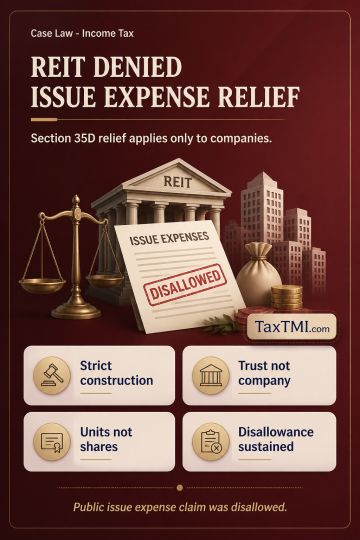
Section 35D(2)(c) was held to allow deduction only to a company for expenditure connected with public subscription of its shares or debentures. The Tribunal applied strict construction and refused to extend that relief to a REIT constituted as a trust, since a business trust is neither a company nor deemed to be one under the Act. It further held that REIT units are legally distinct from shares or debentures, and their regulatory treatment under SEBI norms does not change that character for section 35D(2)(c). The disallowance of the public issue expense claim was therefore sustained.
Section 35D(2)(c) was held to allow deduction only to a company for expenditure connected with public subscription of its shares or debentures. The Tribunal applied strict construction and refused to extend that relief to a REIT constituted as a trust, since a business trust is neither a company nor deemed to be one under the Act. It further held that REIT units are legally distinct from shares or debentures, and their regulatory treatment under SEBI norms does not change that character for section 35D(2)(c). The disallowance of the public issue expense claim was therefore sustained.
Note: It is a system-generated summary and is for quick reference only.
 TaxTMI
 of 4782

















 Join Channel


 TaxTMI