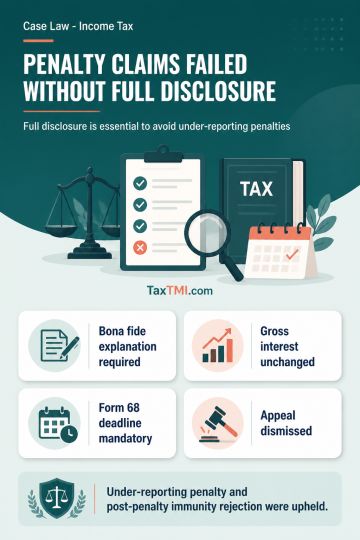
Bona fide disclosure requirements govern under-reporting penalties, and post-penalty immunity applications cannot secure available statutory protectio...
Certificate-of-origin verification procedure governs preferential customs benefits; denial without retroactive verification was set aside with consequ...
Disciplinary Committee jurisdiction and mandatory investigation requirements invalidated cancellation of an insolvency professional's registration and...
Retention of seized property survives where recorded reasons support proceeds of crime, while stayed investigation periods are excluded from limitatio...
Page of 4782
Press 'Enter' after typing page number.
761 to 780 of 95636 Results
❮
❯
❯❯
0 / 200
Expand Note
Add to Folder
No Folders have been created
+
Are you sure you want to delete "My most important" ?
After approval of the corporate insolvency resolution plan by the NCLT, an income-tax assessment founded on a section 148 notice issued only after that approval was impermissible. Applying the principle in Ghanashyam Mishra, the HC treated prior claims as extinguished once the resolution plan was approved, so a post-approval tax demand could not be sustained. The impugned assessment order was therefore unsustainable and was set aside.
After approval of the corporate insolvency resolution plan by the NCLT, an income-tax assessment founded on a section 148 notice issued only after that approval was impermissible. Applying the principle in Ghanashyam Mishra, the HC treated prior claims as extinguished once the resolution plan was approved, so a post-approval tax demand could not be sustained. The impugned assessment order was therefore unsustainable and was set aside.
Note: It is a system-generated summary and is for quick reference only.
 TaxTMI
 of 4782
















 Join Channel



 TaxTMI
