Transfer pricing and tax deductions upheld on established principles, while employee contributions and warranty provisions returned for fresh examinat...
Captive transfer pricing relies on industrial consumer tariffs, while genuine quotations can benchmark effluent treatment transfers under the Other Me...
Specific tariff classification for ophthalmic instruments and extended limitation principles determine the treatment of duty demands, confiscation, an...
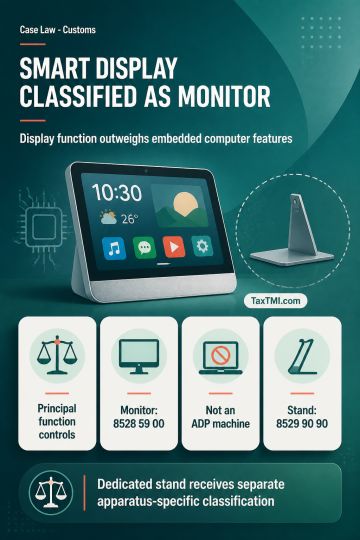
Integrated golf function determines classification, placing launch monitors and simulators under other golf equipment rather than measuring instrument...
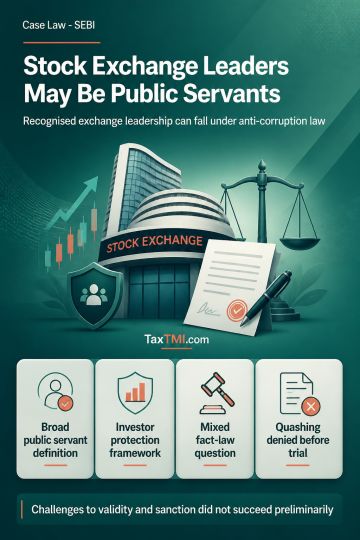
Public servant status under anti-corruption law extends to recognised stock exchange leadership; constitutional and sanction challenges do not succeed...
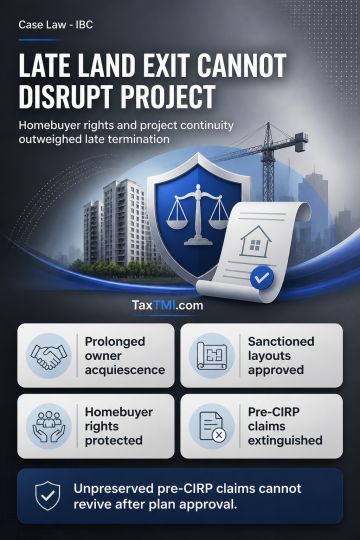
Acquiescence, homebuyer protection and clean-slate resolution principles prevent landowners from disrupting an integrated project through late termina...
Page of 4784
Press 'Enter' after typing page number.
841 to 860 of 95673 Results
❮
❯
❯❯
0 / 200
Expand Note
Add to Folder
No Folders have been created
+
Are you sure you want to delete "My most important" ?
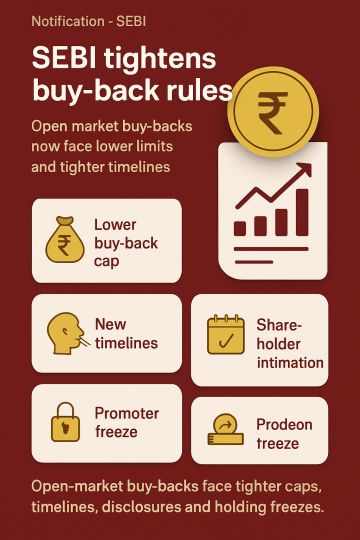
SEBI amended the Buy-Back of Securities Regulations, 2018 to tighten open market buy-back conditions and timelines. From 1 August 2026, open market buy-back through stock exchange must be below 15% of paid-up capital and free reserves, assessed on standalone and consolidated financials, and a company may not propose buy-back that breaches minimum public shareholding norms. The amendments also prescribe fresh announcement, opening and closing timelines, require electronic intimation to existing shareholders, freeze promoter and promoter group holdings at ISIN level during the offer period, and make merchant banker appointment discretionary, with specified compliance duties shifting to the company and other named intermediaries.
SEBI amended the Buy-Back of Securities Regulations, 2018 to tighten open market buy-back conditions and timelines. From 1 August 2026, open market buy-back through stock exchange must be below 15% of paid-up capital and free reserves, assessed on standalone and consolidated financials, and a company may not propose buy-back that breaches minimum public shareholding norms. The amendments also prescribe fresh announcement, opening and closing timelines, require electronic intimation to existing shareholders, freeze promoter and promoter group holdings at ISIN level during the offer period, and make merchant banker appointment discretionary, with specified compliance duties shifting to the company and other named intermediaries.
Note: It is a system-generated summary and is for quick reference only.
 TaxTMI
 of 4784

















 Join Channel


 TaxTMI