Transfer pricing and tax deductions upheld on established principles, while employee contributions and warranty provisions returned for fresh examinat...
Captive transfer pricing relies on industrial consumer tariffs, while genuine quotations can benchmark effluent treatment transfers under the Other Me...
Specific tariff classification for ophthalmic instruments and extended limitation principles determine the treatment of duty demands, confiscation, an...
Integrated golf function determines classification, placing launch monitors and simulators under other golf equipment rather than measuring instrument...
Public servant status under anti-corruption law extends to recognised stock exchange leadership; constitutional and sanction challenges do not succeed...
Acquiescence, homebuyer protection and clean-slate resolution principles prevent landowners from disrupting an integrated project through late termina...
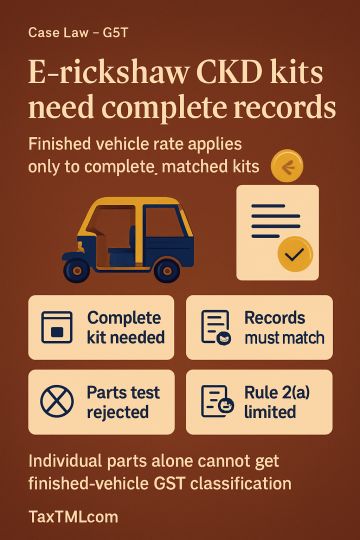
E-rickshaw supplies in CKD/SKD form qualify for GST treatment as the finished electrically operated vehicle only when all components needed to assemble a complete vehicle are supplied together as one identifiable kit or package, and the consignment contents and contemporaneous commercial records consistently match that description. The AAAR rejected the motor-plus-three-components test because it does not arise from Rule 2(a), the tariff, or the rate notification, and held that individual parts cannot be classified as the finished vehicle merely because some are essential components. It also noted that customs interpretative fiction under Rule 2(a) has a limited scope and cannot be extended beyond customs classification.
E-rickshaw supplies in CKD/SKD form qualify for GST treatment as the finished electrically operated vehicle only when all components needed to assemble a complete vehicle are supplied together as one identifiable kit or package, and the consignment contents and contemporaneous commercial records consistently match that description. The AAAR rejected the motor-plus-three-components test because it does not arise from Rule 2(a), the tariff, or the rate notification, and held that individual parts cannot be classified as the finished vehicle merely because some are essential components. It also noted that customs interpretative fiction under Rule 2(a) has a limited scope and cannot be extended beyond customs classification.
Note: It is a system-generated summary and is for quick reference only.
 TaxTMI
 of 4784





















 Join Channel


 TaxTMI