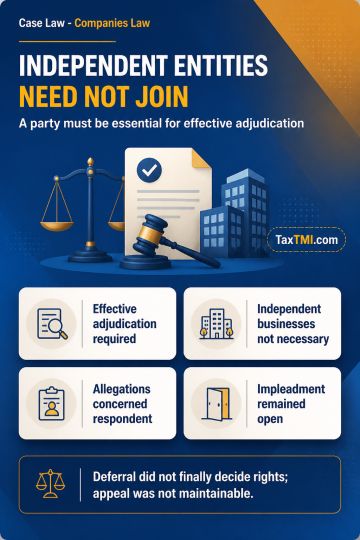
Necessary-party requirements limit impleadment of independent entities, while deferred consideration does not create an appealable adverse determinati...
Food supplement classification requires common parlance and authoritative tests, preventing treatment as proprietary Ayurvedic medicines without suppo...
Specified regulatory authority income receives conditional tax exemption, subject to non-commercial activity, unchanged income character, and return f...
Tax exemption for regulatory authority income applies retrospectively, subject to non-commercial activity, unchanged income sources, and return-filing...
Input tax credit conditions remain constitutionally valid, with eligible recipient claims considered under GST circulars and retrospective filing dead...
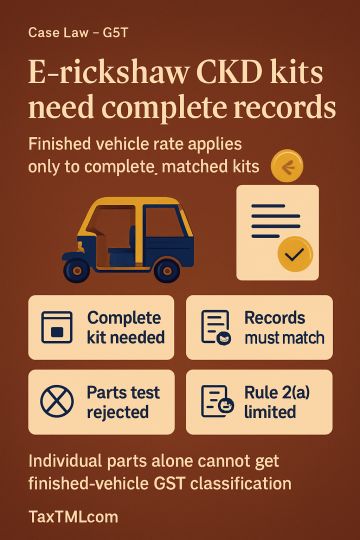
E-rickshaw supplies in CKD/SKD form qualify for GST treatment as the finished electrically operated vehicle only when all components needed to assemble a complete vehicle are supplied together as one identifiable kit or package, and the consignment contents and contemporaneous commercial records consistently match that description. The AAAR rejected the motor-plus-three-components test because it does not arise from Rule 2(a), the tariff, or the rate notification, and held that individual parts cannot be classified as the finished vehicle merely because some are essential components. It also noted that customs interpretative fiction under Rule 2(a) has a limited scope and cannot be extended beyond customs classification.
E-rickshaw supplies in CKD/SKD form qualify for GST treatment as the finished electrically operated vehicle only when all components needed to assemble a complete vehicle are supplied together as one identifiable kit or package, and the consignment contents and contemporaneous commercial records consistently match that description. The AAAR rejected the motor-plus-three-components test because it does not arise from Rule 2(a), the tariff, or the rate notification, and held that individual parts cannot be classified as the finished vehicle merely because some are essential components. It also noted that customs interpretative fiction under Rule 2(a) has a limited scope and cannot be extended beyond customs classification.
Note: It is a system-generated summary and is for quick reference only.
 TaxTMI
 of 4792


















 Join Channel


 TaxTMI

