Institutional incapacity in customs settlement proceedings excludes non-functional quorum periods from statutory disposal timelines, preventing automa...
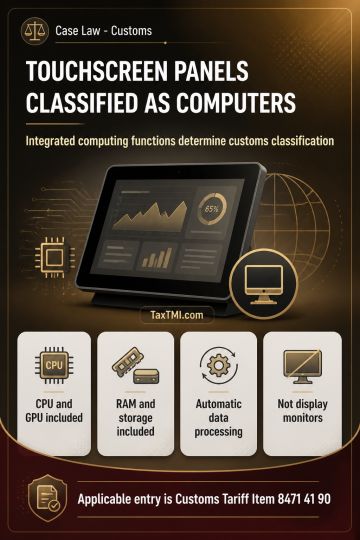
Interactive touchscreen panels with integrated computing functions fall under automatic data-processing machines rather than display monitors for cust...
Ex parte injunction service requirements were substantially met, while civil recovery and SFIO investigation into provident fund defalcation continued...
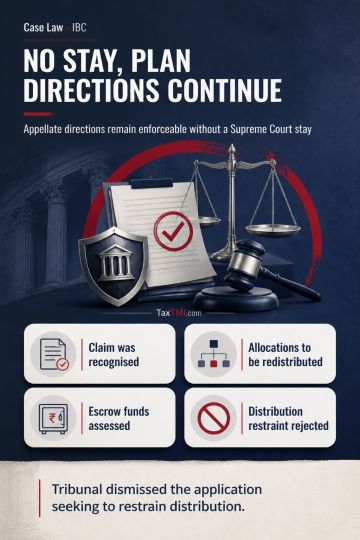
Enforcement of resolution-plan directions continues without a Supreme Court stay, preventing suspension of redistribution and escrowed-fund distributi...
Third-party ownership claims over attached property require Special Court adjudication where purchasers lack registered sale deeds and bona fides rema...
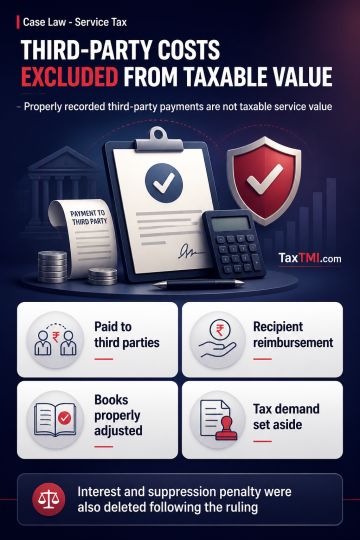
Pure-agent reimbursements in clearing and forwarding services are excluded from taxable value when qualifying third-party payments are properly record...
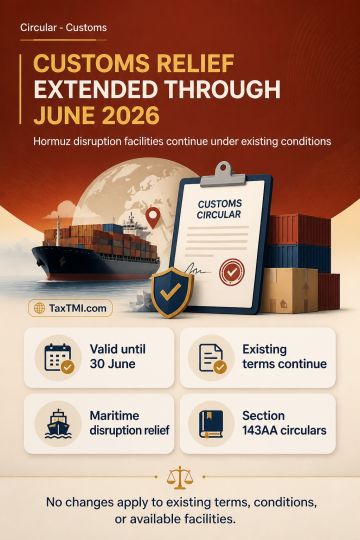
Customs relief for Strait of Hormuz maritime disruptions remains available, with existing conditions continuing unchanged through the extended validit...
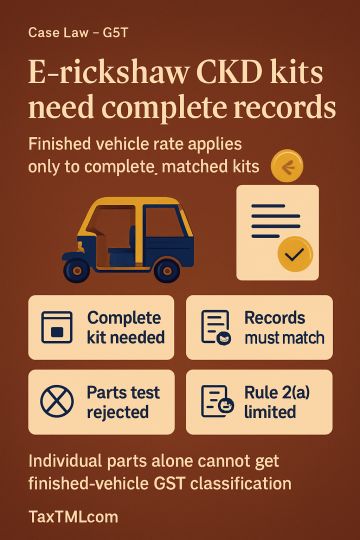
E-rickshaw supplies in CKD/SKD form qualify for GST treatment as the finished electrically operated vehicle only when all components needed to assemble a complete vehicle are supplied together as one identifiable kit or package, and the consignment contents and contemporaneous commercial records consistently match that description. The AAAR rejected the motor-plus-three-components test because it does not arise from Rule 2(a), the tariff, or the rate notification, and held that individual parts cannot be classified as the finished vehicle merely because some are essential components. It also noted that customs interpretative fiction under Rule 2(a) has a limited scope and cannot be extended beyond customs classification.
E-rickshaw supplies in CKD/SKD form qualify for GST treatment as the finished electrically operated vehicle only when all components needed to assemble a complete vehicle are supplied together as one identifiable kit or package, and the consignment contents and contemporaneous commercial records consistently match that description. The AAAR rejected the motor-plus-three-components test because it does not arise from Rule 2(a), the tariff, or the rate notification, and held that individual parts cannot be classified as the finished vehicle merely because some are essential components. It also noted that customs interpretative fiction under Rule 2(a) has a limited scope and cannot be extended beyond customs classification.
Note: It is a system-generated summary and is for quick reference only.
 TaxTMI
 of 4794















 Join Channel


 TaxTMI