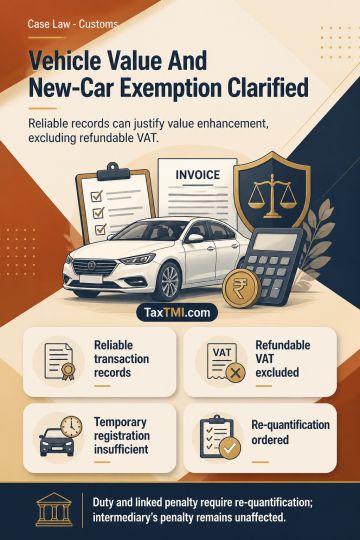
Transaction value rejection requires reliable corroboration; refundable VAT is excluded and temporary registration does not defeat new-vehicle exempti...
Appellate jurisdiction remains available where a wrist-worn gold ornament cannot conclusively be characterised as imported baggage at the preliminary ...
Written complaint requirement bars cognizance on police reports for securities offences, while unsupported breach of trust and cheating allegations fa...
Risk-based postal import clearance standardises electronic assessment, document requests, duty realisation and delivery controls at Foreign Post Offic...
Page of 4794
Press 'Enter' after typing page number.
221 to 240 of 95875 Results
❮
❯
❯❯
0 / 200
Expand Note
Add to Folder
No Folders have been created
+
Are you sure you want to delete "My most important" ?
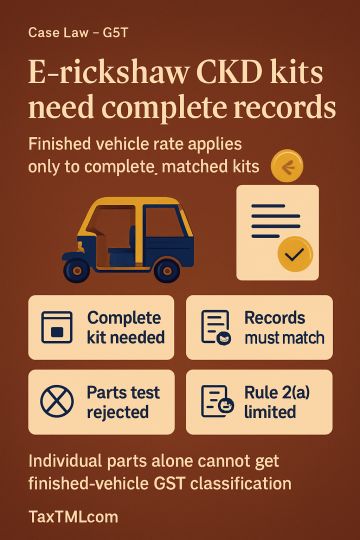
E-rickshaw supplies in CKD/SKD form qualify for GST treatment as the finished electrically operated vehicle only when all components needed to assemble a complete vehicle are supplied together as one identifiable kit or package, and the consignment contents and contemporaneous commercial records consistently match that description. The AAAR rejected the motor-plus-three-components test because it does not arise from Rule 2(a), the tariff, or the rate notification, and held that individual parts cannot be classified as the finished vehicle merely because some are essential components. It also noted that customs interpretative fiction under Rule 2(a) has a limited scope and cannot be extended beyond customs classification.
E-rickshaw supplies in CKD/SKD form qualify for GST treatment as the finished electrically operated vehicle only when all components needed to assemble a complete vehicle are supplied together as one identifiable kit or package, and the consignment contents and contemporaneous commercial records consistently match that description. The AAAR rejected the motor-plus-three-components test because it does not arise from Rule 2(a), the tariff, or the rate notification, and held that individual parts cannot be classified as the finished vehicle merely because some are essential components. It also noted that customs interpretative fiction under Rule 2(a) has a limited scope and cannot be extended beyond customs classification.
Note: It is a system-generated summary and is for quick reference only.
 TaxTMI
 of 4794










 Join Channel


 TaxTMI