Time-share accommodation classification excludes Club or Association Service where purchasers receive contractual occupancy rights without genuine mem...
CENVAT credit for trading requires reversal, while taxable-service rental credit remains proportionately available and limitation issues await resolut...
Vicarious liability for dishonoured company cheques may extend to non-signatory directors where complaints contain foundational responsibility avermen...
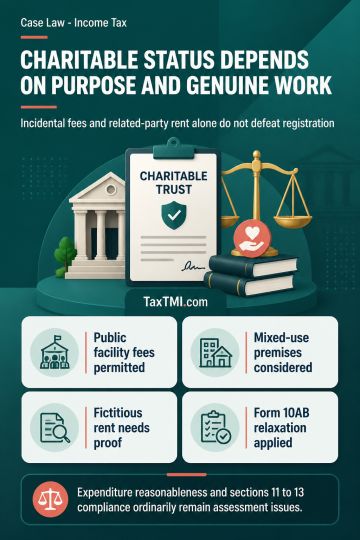
Charitable registration turns on predominant purpose and genuine activities, while incidental fees and related-party rent require supporting adverse m...
Page of 4794
Press 'Enter' after typing page number.
121 to 140 of 95875 Results
❮
❯
❯❯
0 / 200
Expand Note
Add to Folder
No Folders have been created
+
Are you sure you want to delete "My most important" ?
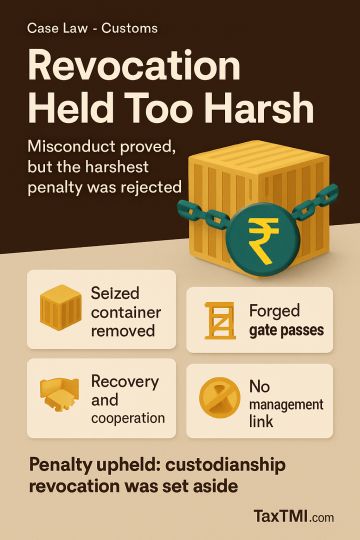
Illegal removal of a seized container and substitution through forged gate passes was treated as a serious breach of HCCAR supervision and customs compliance, but revocation of custodianship was held to be a disproportionate response. The Tribunal noted recovery of the goods, police findings showing no material against management, cooperation with investigation, and corrective measures taken thereafter. It upheld penalty for the violations but declined the severest consequence of revocation. On vicarious liability, it held that employee misconduct alone, without evidence of knowledge, connivance or conscious facilitation by management, could not justify revocation, and the Department failed to show grounds for appellate interference.
Illegal removal of a seized container and substitution through forged gate passes was treated as a serious breach of HCCAR supervision and customs compliance, but revocation of custodianship was held to be a disproportionate response. The Tribunal noted recovery of the goods, police findings showing no material against management, cooperation with investigation, and corrective measures taken thereafter. It upheld penalty for the violations but declined the severest consequence of revocation. On vicarious liability, it held that employee misconduct alone, without evidence of knowledge, connivance or conscious facilitation by management, could not justify revocation, and the Department failed to show grounds for appellate interference.
Note: It is a system-generated summary and is for quick reference only.
 TaxTMI
 of 4794




 Join Channel


 TaxTMI