Bogus donation receipts justified commission income assessment and defeated political-party tax exemption for inaccurate accounts and reporting failur...
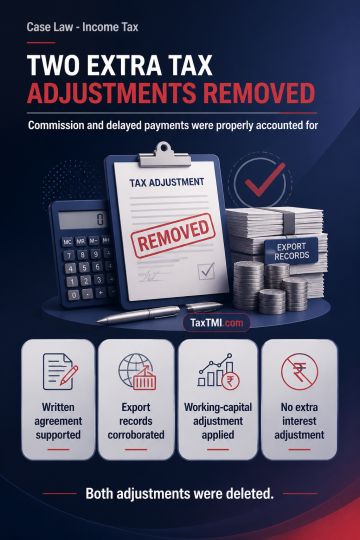
Pure reimbursement without income element escapes tax withholding, while delayed withholding and unsupported provisions face deferred or renewed scrut...
Public benefit requirement defeats charitable registration where residents' association services are reciprocal, member-only facilities governed by mu...
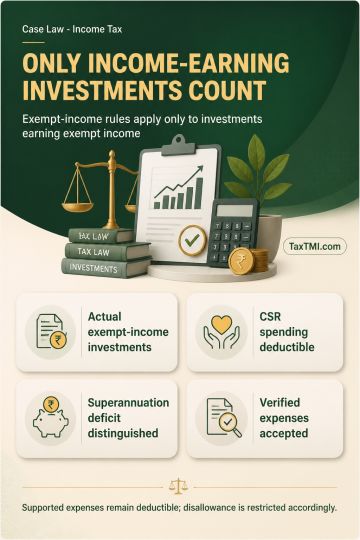
Exempt-income expenditure disallowance is confined to investments that actually generated exempt income, while supported business expenses remain dedu...
Objective characteristics and principal use govern mining-tyre classification, while fresh advance ruling applications may rely on additional technica...
Page of 4792
Press 'Enter' after typing page number.
541 to 560 of 95832 Results
❮
❯
❯❯
0 / 200
Expand Note
Add to Folder
No Folders have been created
+
Are you sure you want to delete "My most important" ?
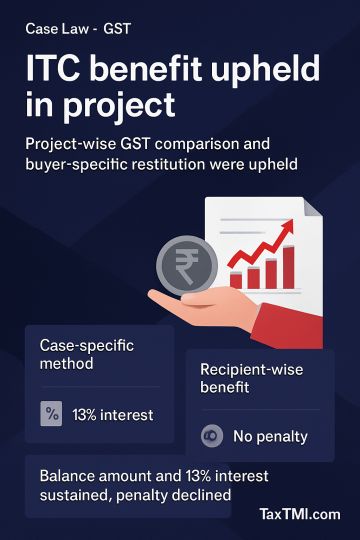
Project-wise anti-profiteering analysis under GST upheld where the Tribunal accepted a case-specific methodology for comparing pre-GST and post-GST ITC, allocated the benefit across similarly situated homebuyers, and rejected objections on natural justice, scope of inquiry, and time limits. It found that additional input tax credit had arisen in the project, that the respondent had not passed on the full recipient-specific benefit, and that excess benefit given to some buyers could not offset shortfall owed to others. The balance amount was sustained with 18% compensatory interest, but penalty was declined because the penal provision was held inapplicable to the period in question.
Project-wise anti-profiteering analysis under GST upheld where the Tribunal accepted a case-specific methodology for comparing pre-GST and post-GST ITC, allocated the benefit across similarly situated homebuyers, and rejected objections on natural justice, scope of inquiry, and time limits. It found that additional input tax credit had arisen in the project, that the respondent had not passed on the full recipient-specific benefit, and that excess benefit given to some buyers could not offset shortfall owed to others. The balance amount was sustained with 18% compensatory interest, but penalty was declined because the penal provision was held inapplicable to the period in question.
Note: It is a system-generated summary and is for quick reference only.
 TaxTMI
 of 4792

















 Join Channel


 TaxTMI