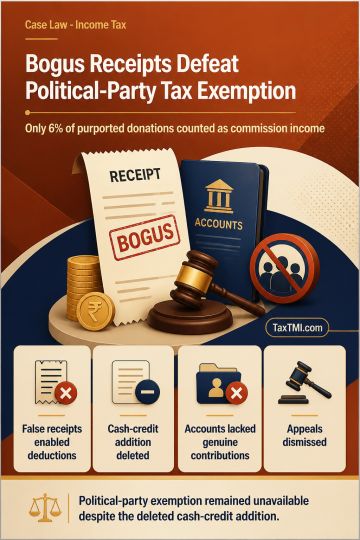
Bogus donation receipts justified commission income assessment and defeated political-party tax exemption for inaccurate accounts and reporting failur...
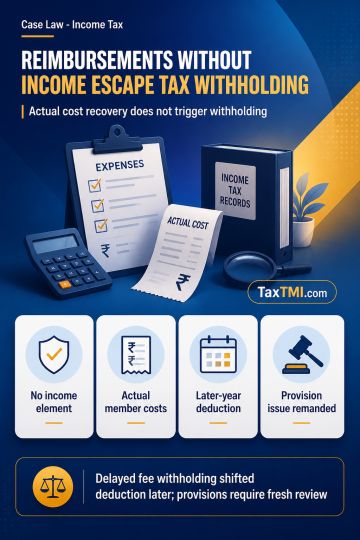
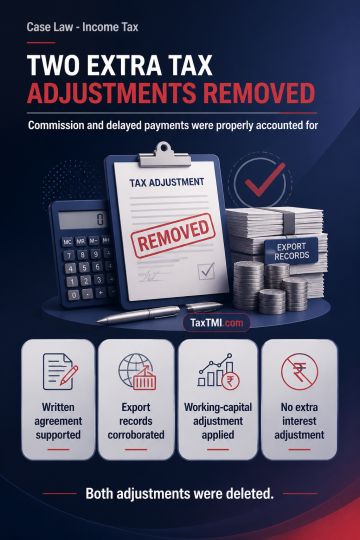
Pure reimbursement without income element escapes tax withholding, while delayed withholding and unsupported provisions face deferred or renewed scrut...
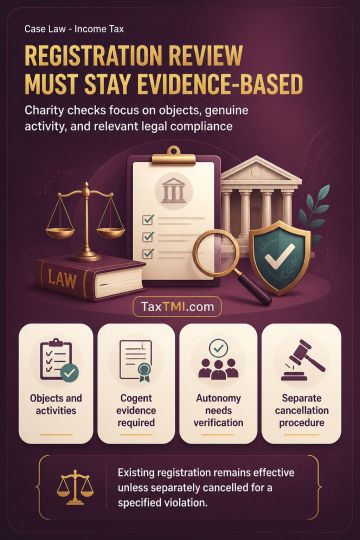
Public benefit requirement defeats charitable registration where residents' association services are reciprocal, member-only facilities governed by mu...
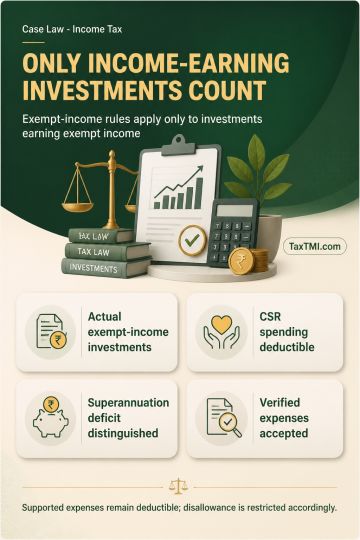
Exempt-income expenditure disallowance is confined to investments that actually generated exempt income, while supported business expenses remain dedu...
Objective characteristics and principal use govern mining-tyre classification, while fresh advance ruling applications may rely on additional technica...
Page of 4794
Press 'Enter' after typing page number.
581 to 600 of 95872 Results
❮
❯
❯❯
0 / 200
Expand Note
Add to Folder
No Folders have been created
+
Are you sure you want to delete "My most important" ?
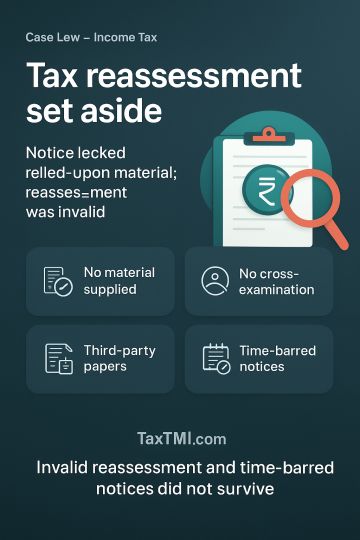
ITAT upheld invalid reassessment where the show-cause notice under the reopening procedure was not accompanied by the relied-upon material, despite the assessee's request, and held that RMS or Insight inputs did not dispense with independent verification, disclosure of material, or observance of natural justice. It further held that the appellate authority could test the legality of the reopening while hearing the reassessment appeal. Additions based on third-party seized papers, statements and loose sheets failed because the material was not properly furnished, cross-examination was denied, and the documents were uncorroborated. Section 69A was held inapplicable to alleged cash borrowing. Later-year notices were also held time-barred, so the consequential reassessments did not survive.
ITAT upheld invalid reassessment where the show-cause notice under the reopening procedure was not accompanied by the relied-upon material, despite the assessee's request, and held that RMS or Insight inputs did not dispense with independent verification, disclosure of material, or observance of natural justice. It further held that the appellate authority could test the legality of the reopening while hearing the reassessment appeal. Additions based on third-party seized papers, statements and loose sheets failed because the material was not properly furnished, cross-examination was denied, and the documents were uncorroborated. Section 69A was held inapplicable to alleged cash borrowing. Later-year notices were also held time-barred, so the consequential reassessments did not survive.
Note: It is a system-generated summary and is for quick reference only.
 TaxTMI
 of 4794




 Join Channel


 TaxTMI