Clean slate principle extinguishes uncrystallised operational claims and bars continuation of pending recovery and arbitral proceedings after plan app...
Works contract classification governs composite layout-development contracts where VAT-paid goods are transferred alongside construction and infrastru...
Page of 4788
Press 'Enter' after typing page number.
761 to 780 of 95749 Results
❮
❯
❯❯
0 / 200
Expand Note
Add to Folder
No Folders have been created
+
Are you sure you want to delete "My most important" ?
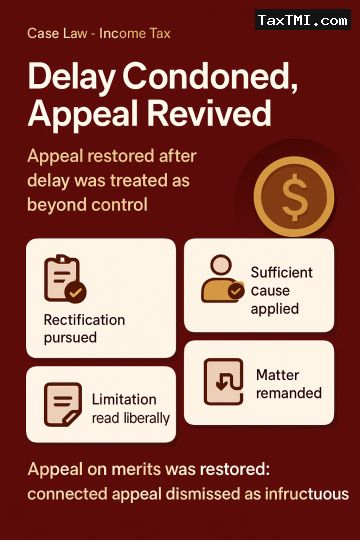
Delay in filing the appeal against the intimation under section 143(1) was condoned because the assessee had pursued rectification and a reminder, and the time taken in that process was treated as beyond its control. Applying the principle of sufficient cause, the Tribunal held that limitation provisions should be construed liberally to advance substantial justice where there is no negligence, inaction or lack of bona fides. The order dismissing the appeal on limitation was set aside and the matter was restored for decision on merits. The connected appeal against the rectification order was dismissed as infructuous after restoration of the main appeal.
Delay in filing the appeal against the intimation under section 143(1) was condoned because the assessee had pursued rectification and a reminder, and the time taken in that process was treated as beyond its control. Applying the principle of sufficient cause, the Tribunal held that limitation provisions should be construed liberally to advance substantial justice where there is no negligence, inaction or lack of bona fides. The order dismissing the appeal on limitation was set aside and the matter was restored for decision on merits. The connected appeal against the rectification order was dismissed as infructuous after restoration of the main appeal.
Note: It is a system-generated summary and is for quick reference only.
 TaxTMI
 of 4788





















 Join Channel


 TaxTMI